Two caricatures, neither real
Day trading arrives wrapped in two stories. One is the highlight reel: the screenshot of a five-figure day, the implication that a few good setups stand between anyone and quitting their job. The other is the cautionary tale: everyone loses, it is a casino, do not even start. Both are caricatures, and both are popular for the same reason — they are simple, and the truth is not.
Easy money
Five-figure days, a few clean setups between you and quitting your job. Simple, and false.
A rigged casino
Everyone loses, do not even start. Also simple — and wrong about why.
The reality sits in the quieter middle, and it is made of two facts that neither story tells. The first is about the market. The second is about you. To be clear about the base rate: most day traders lose money over time, and the research says so plainly. The caricature isn't the loss rate — it's the claim that the outcome is pure chance and your own behavior plays no part.
The first reality: variance
Even an approach with a genuine edge — one that makes money over a large enough sample — produces long stretches that look like failure. A positive expectancy does not mean steady gains; it means the gains outweigh the losses eventually, across many trades, with plenty of losing runs in between. A trader can do everything right for two weeks and still be down, because variance does not owe anyone a smooth line.
This is why the drawdown math matters more than the win rate. A string of losses is not proof the approach is broken; it is often just the sample being small. The discipline is to size each trade so a normal losing streak cannot end the account before the edge has room to play out. The drawdown recovery math shows how steep that gets when sizing slips: a 50% loss needs a 100% gain just to get back to even. Surviving variance is the first job, and most accounts that fail, fail here — not on the entries, on the sizing.
The second reality: it is mostly you
The other half of the reality is harder to hear: once the strategy is decided, the biggest controllable variable left is the trader's own behavior. The same setup, taken calm versus taken on tilt, is effectively two different trades. The market sets the odds; the trader's state decides how faithfully those odds get played.
This is the gap between a strategy edge and a behavioral edge. A strategy can be sound on paper and still lose in practice, because the person running it sizes up after a win, chases after a loss, or holds a loser hoping it comes back. The reality of day trading is that the chart is the easy part. The hard part is doing the same correct thing whether you are up, down, bored, or rushed. The behavioral mechanisms behind those slips are well documented — see how emotions affect trading performance.
The reality you can't see by feel
Here is the part that stays hidden: which of these behaviors is actually costing you. Every trader's profile is different. For one, the damage is concentrated in revenge entries after a loss; for another, oversizing on a hot streak; for another, the trades taken in the first restless hour. Memory is no help, because the trades you remember are the dramatic ones, not the representative ones — and the representative ones are what set your results.
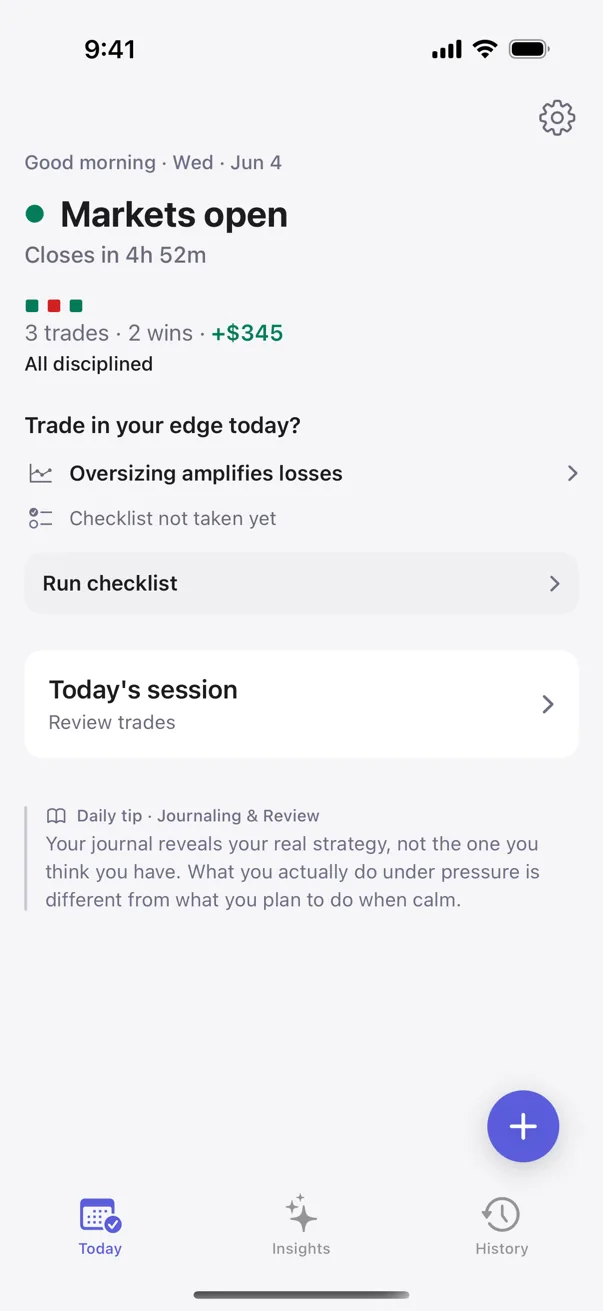
It is measurable, though, and that is the honest path through the noise. Log each trade with the state you were in, give it enough of a sample, and the costly conditions separate from the random ones, with the sample size attached so you know how much to trust each. That is what Kyra does on your own history; the mechanics are in pattern detection.
The trades you remember are not the trades that set your results.
What the reality means in practice
Three things follow from taking the reality seriously instead of either caricature:
- Survive the variance.Size each trade to a fixed, known risk so a normal losing streak is survivable. The position size calculator turns "how much could I lose" into a number you set on purpose.
- Control the controllable.You cannot control the market. You can control whether you take a trade in a state you have no business trading in. A pre-trade checklist makes that a gate instead of a hope.
- Measure your own behavior.Not the market's, yours. The reality of your results lives in your own trade history, not in anyone else's screenshots.
The reality of day trading is sober, not bleak: a real approach, sized to survive variance, executed by a trader who knows which of their own states cost them. Two of those three are about you, and both are measurable. See what your own history says.