The market answer and the trader answer
Ask "what's the best time of day to trade" and almost every answer you'll find is about the market. The first hour after the open has the most volume and the widest ranges. The midday lull is thinner and choppier. The last hour picks back up as positions get squared. All of that is true, and all of it describes the instrument — when the tape moves, when spreads widen, when liquidity is there.
It's the wrong half of the question for most traders. The market's clock is the same for everyone trading the session. What differs hour to hour within a single trader is the quality of the decisions being made. The same chart, read by a sharp mind at 9:30 and a depleted one at 1:00, is effectively two different trades. The better question is not "when does the market move best" — it's "when do I decide best, and when do I stop."
When the tape moves
Open volatility, the midday lull, the closing hour. True, and identical for everyone trading the session. It describes the instrument, not the trader.
When you decide best
Decision quality rises and falls across a session. Your sharp window and your slump are yours — and they sit in your own log, not in a generic "best hours" chart.
Decision fatigue is real
The idea that judgment degrades over a run of decisions is not folk wisdom — it has been measured directly, in settings where the stakes were high and the decision-makers were experts.
The cleanest (if contested) demonstration comes from a study of judicial parole rulings [1]. Tracking experienced judges across the working day, researchers found the proportion of favorable rulings started high at each session's beginning, declined steadily toward near zero as the session wore on, then reset sharply after the judges took a break. Same judges, same kinds of cases — position in the sequence, and whether a break had intervened, moved the outcomes. Repeated deciding wore the judgment down; rest restored it.
The mechanism underneath has its own line of research. A series of experiments on self-control [2] found that acts of willpower and deliberate choice draw down a shared, limited resource — a phenomenon the authors named ego depletion. Exert self-control on one task and performance on an unrelated act of control immediately afterward measurably suffers. Deciding, resisting, and overriding impulses are not free; they spend something that doesn't replenish instantly.
Put both findings next to a trading session and the implication is direct. Trading is a dense stream of exactly the decisions both studies describe — judgment calls under uncertainty, impulses to resist, plans to override or hold. The trader making the first call of the day and the trader making the fifteenth share a name and an account. They do not share the same reserves.
What it looks like in trading
Decision fatigue doesn't announce itself. It shows up as a quiet loosening — the same trader, later in the session, doing things a fresher version of themselves wouldn't:
- Criteria slip — a setup that wouldn't have cleared the bar at 9:30 gets waved through at 1:30, because scrutinizing it costs effort the trader no longer has to spend
- Size creeps — positions drift above baseline, sized to boredom or to the urge to make the day interesting rather than to the setup's risk
- Marginal trades multiply — more entries on thinner reasons, the "might as well" trades that a sharp morning would have passed on
- The afternoon slump — for many session traders the back half of the day is where the give-back lives, not because the market changed but because the decision-maker did
None of this requires a dramatic trigger like a hard loss — which is what separates it from tilt or a revenge sequence. Fatigue is the baseline cost of having decided all morning; it arrives on a perfectly ordinary, even profitable, day. The give-back is gradual, and because it's gradual, it's easy to miss in the moment and easy to forget by the next session.
The fingerprint in your trade log
Like every behavioral pattern, the fatigue slump leaves a trace. If you bin your trades by the hour or session phase they were entered and look at win rate or expectancy in each bin, the curve tends to have a shape: strong where the decision-maker is fresh, sagging through the stretch where the session has worn them down, sometimes recovering near the close as a second wind or the urgency of squaring up sharpens focus again.
Read that chart as a template, not a verdict. The average curve is not your curve. Some traders are sharpest at the open and fade by lunch; others warm up slowly and do their best work mid-session; a night-owl trading an overseas session inverts the standard picture entirely. What matters is the curve your own timestamps draw — which is why this is something to measure rather than assume.
How to use it
Once you know roughly where your sharp window sits and where your slump tends to fall, the moves are structural — decided in advance, so the depleted version of you isn't asked to out-think their own depletion in the moment.
1. Schedule your highest-stakes decisions for your sharp window
If a setup is bigger, more discretionary, or harder to read, take it when your judgment is freshest, not when it's worn down. Treat your best hour as a scarce resource and spend it on the decisions that most reward a clear head. The marginal afternoon trade is exactly the one your sharp window would have passed on anyway.
2. Pre-commit to stop when fatigue sets in
Decide, before the session, the point at which you stop opening new positions — a clock time, a trade count, or both. Binary rules survive fatigue because there's no judgment call left to make: either you've hit the cutoff or you haven't. The depleted trader can't be trusted to assess their own depletion, so don't make them; let the rule the fresh trader wrote do the assessing. Sizing the day's risk in advance is part of this — a pre-set position size stops the bored late-session trader from quietly sizing to the feeling.
3. Take real breaks — they reset
The parole study's most useful detail for traders isn't that judgment declined — it's that a break brought it back [1]. Rest is not a reward for getting through the session; it's the thing that restores the decision quality the session spent. A genuine step away from the screen — not a glance-away while still watching the tape — resets the reserve the way nothing else in the session does.
Measuring it
The reason the fatigue curve is hard to fix from memory is the reason it's tractable from data: you don't remember your representative trades, you remember your dramatic ones, and the dramatic ones don't sit at any particular hour. The timestamps don't have that problem. Every trade already carries the time it was entered. Binning outcomes by that time turns a vague sense of "I think I trade worse in the afternoon" into a curve with numbers on it.
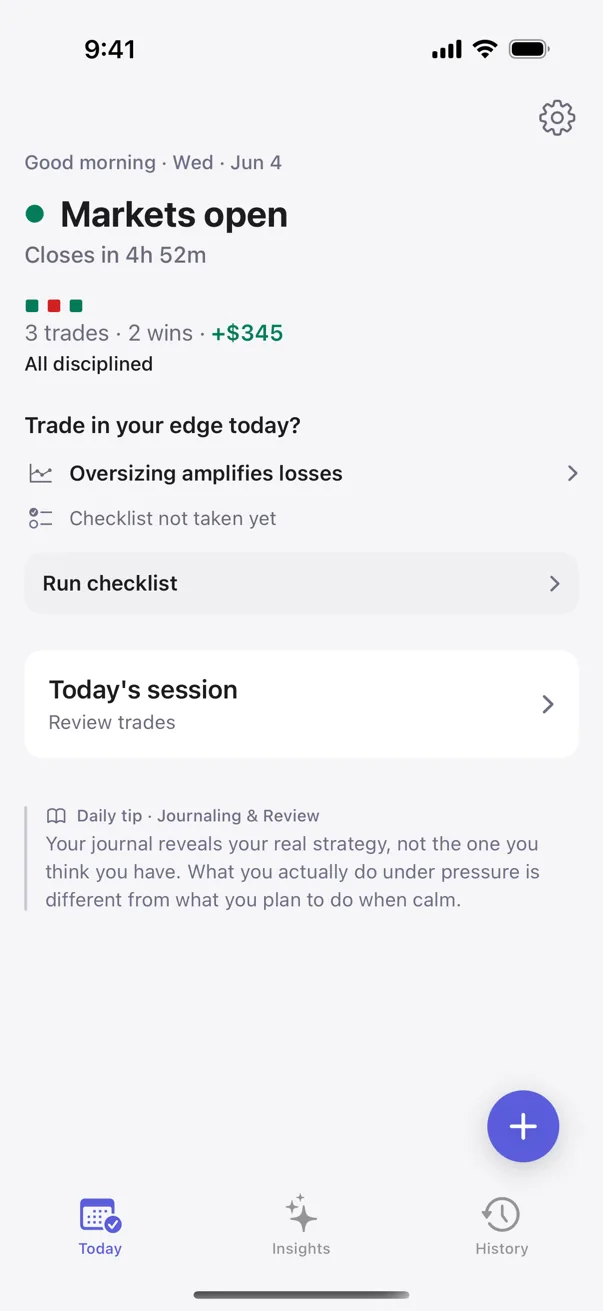
This is what behavioral pattern detection measures. Kyra bins your outcomes by time of day and surfaces your own performance curve as a pattern — the hours where your win rate or expectancy runs below your baseline, with a sample size attached. The output isn't a generic "trade your best hours" tip. It's a measurement: the trades you entered in this window returned X% less than your baseline, with a confidence range that tightens as the sample grows.
Kyra Trading is a private trading journal that does this detection on-device. The engine tests repeated differences against noise and labels each pattern by how much data stands behind it — Tracking, Emerging, Developing, or Established — so a time-of-day signal earns trust only as the evidence accumulates. Every pattern surface includes the sample size and a confidence range, so the trader can see how strong the signal is. Nothing leaves the device. Pattern detection runs locally, no accounts, no servers. The trader's data stays the trader's data.
Sources
- Danziger, S., Levav, J., & Avnaim-Pesso, L. (2011). Extraneous factors in judicial decisions. Proceedings of the National Academy of Sciences, 108(17), 6889–6892.
- Baumeister, R. F., Bratslavsky, E., Muraven, M., & Tice, D. M. (1998). Ego depletion: Is the active self a limited resource? Journal of Personality and Social Psychology, 74(5), 1252–1265.
Educational only. Not financial or trading advice. Behavioral patterns described above are observations from the published literature; specific outcomes vary with strategy, market conditions, and individual circumstances.