The recovery curve
Read down the second column. Every row asks more of the trader than the loss took. By 50% the requirement doubles. By 90% it grows to a tenfold gain. At 100% the math breaks because there is nothing left to compound.
| Loss of capital | Gain required to recover |
|---|---|
| 10% | 11.11% |
| 20% | 25% |
| 30% | 42.85% |
| 40% | 66.66% |
| 50% | 100% |
| 60% | 150% |
| 70% | 233% |
| 80% | 400% |
| 90% | 900% |
| 100% | no recovery |
This is not advice and it is not a warning. It is arithmetic. Understanding the curve is the precondition for every other risk-management decision a trader makes.
Why the math is asymmetric
The recovery percentage is calculated against a smaller account than the loss percentage was. That single fact drives the whole curve.
Concrete example: start with $10,000. Lose 50%, account is $5,000. To return to $10,000, the gain has to be $5,000 — which is 100% of the new $5,000 base. The loss percentage was calculated against $10,000. The gain percentage is calculated against $5,000. The bases are different.
The general formula:
Where Loss is expressed as a decimal. Plug in 0.5 and the formula returns 1.0 — a 100% gain. Plug in 0.9 and the formula returns 9.0 — a 900% gain. Plug in 0.99 and it returns 99 — a 99% loss requires a 9,900% gain. At 1.0, the formula divides by zero. There is no recovery percentage from a 100% loss.
Trading account dynamics are multiplicative, not additive. Each trade scales the previous balance by some factor. Multiplicative systems are not symmetric around zero. A +10% followed by a −10% does not return the account to start; it leaves the account at 99% of the original. Run that asymmetry over enough trades and the geometric path of an account always sits below the arithmetic average of its returns.
Where the asymmetry hits hardest
Read the table again. The first 30% of the curve is gentle: 10% needs 11.11%, 20% needs 25%, 30% needs 42.85%. These are recoverable inside a normal trading horizon for most strategies.
Beyond 30%, the curve steepens fast. A 50% drawdown requires the trader to double the remaining capital just to return to start. A 75% drawdown requires a 300% gain. Past 80%, the math becomes punitive in a way most strategies cannot deliver in any practical timeframe.
This is why depth of drawdown is the first-order risk metric, not frequency of drawdown. A trader who hits a 20% drawdown four times a year is fine. A trader who hits 50% once is in serious trouble. The shallow drawdowns recover quickly. The deep ones break the math.
The four levers that bound drawdown depth
The recovery math above is fixed. What is not fixed is how deep the drawdown gets — and that is a function of four levers. Every one of them is set by the trader before the trade, not during it.
1. Position size per trade
The single biggest lever. A trader risking 1% of current equity can absorb 100 consecutive losses and still hold roughly a third of the account — and most strategies, even bad ones, do not lose anything close to that in a row. A trader risking 5% per trade is down about 64% after 20 consecutive losses — deep in the punitive part of the recovery curve. Use a position size calculator to lock the number before market open; the post-loss trader cannot be trusted to size correctly.
2. Daily loss limit
A pre-defined percentage of the account that ends the trading day when hit. Common discipline numbers sit between 2% and 5%. The exact figure matters less than the rule existing in writing before the day begins. Without a daily loss limit, a single bad session can carry an account from a manageable 10% drawdown to a structural 50% drawdown. The math curve reflects exactly what that costs.
3. Leverage
Leverage multiplies position size beyond what the cash account would otherwise allow. A 2x leveraged position with a 10% adverse move loses 20% of the cash that backs it. A trader using 4x leverage on a position they would otherwise size at 1% is effectively risking 4% per trade against the cash account. Leverage does not change the recovery math curve; it changes how fast a trader walks down it.
4. Time spent compounding in drawdown
Drawdowns deepen when a trader keeps trading through them. A trader who hits a 20% drawdown and continues at full size — instead of pausing or reducing — frequently turns 20% into 35% before the cycle resets. The planned reward:risk discipline shown by the risk/reward calculator helps quantify the setup before entry; realized outcomes belong in the post-trade record.
The levers are not equal
Position size dominates. The other three matter, but a trader who has position size correct can survive sloppy execution on the others; a trader who has position size wrong will eventually find a drawdown the math does not recover from, regardless of how disciplined they are on the rest.
This means drawdown management is, mathematically, a position-sizing problem first. Everything else is second-order.
The behavioral wedge — sizing drift
Position size is the dominant lever, but trader-set position size is rarely stable. Sizing drifts upward over a streak of wins (overconfidence) and upward again after a loss (the make-it-back trap, discussed in detail in how to stop revenge trading). Both directions of drift make subsequent drawdowns deeper than the trader's stated risk policy would allow.
This is the part of drawdown management that is not a math problem. The math is solved on paper. The problem is that the trader who set the 1% rule at the start of the year is not the same trader, in the same emotional state, on the day a 5% impulse looks reasonable. Behavioral finance research on cortisol and cognitive control under stress [1] supports the same point: the post-loss decision-maker is not the rule-maker.
The structural answer: pre-commit to sizing rules in writing, run them through a calculator, and surface drift as data when it happens — not as a warning, as a measurement.
The measurement layer
Position-sizing drift is a measurable behavior in a trader's own log. The size on a given trade can be compared against the trader's stated rule, against the average of the last N trades, and against the size that immediately followed each recent loss. Statistically, these comparisons surface the sizing-discipline pattern long before the drawdown gets deep.
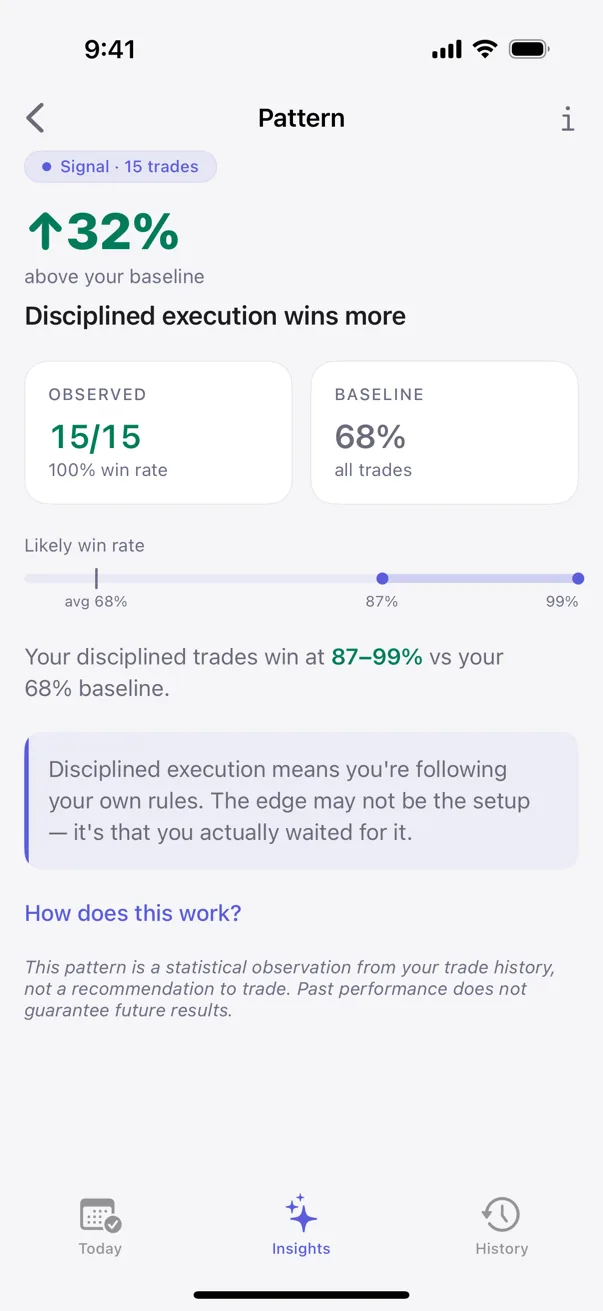
Kyra is a private trading journal that runs this kind of pattern detection on-device. Pattern detection across the user's own trade history surfaces sequences where sizing crept upward, where post-loss sizing diverged from the trader's average, and where the sizing-execution gap accelerated drawdown depth. Nothing leaves the device — pattern detection runs locally, no accounts, no servers.
The math from this article does not change. What Kyra adds is the measurement of the sizing behavior that bounds where on the math curve a trader actually lands.
Sources
- Coates, J. M., & Herbert, J. (2008). Endogenous steroids and financial risk taking on a London trading floor. Proceedings of the National Academy of Sciences, 105(16), 6167–6172.
Educational only. Not financial or trading advice. The recovery math is arithmetic; specific outcomes vary with strategy, market conditions, leverage, fees, and slippage.