What revenge trading actually is
Revenge trading is a trade taken primarily to win back a previous loss rather than because the new setup independently meets the trader's plan. That definition is about motive. A trade log does not get motive for free.
Three observable clues can make a post-loss sequence worth reviewing:
- A recent loss — often within the same session
- A compressed re-entry interval — the next trade arrives faster than the trader's own baseline
- A change in execution — position size, stop intent, setup quality, or another recorded process field shifts after the loss
If those clues line up, the next trade deserves scrutiny. They show that behavior changed after a loss. They do not, by themselves, prove why the trade was taken.
The trade stands on its own
The setup qualifies on its own merits, size fits the plan, and the previous trade gets no vote.
The sequence changed
The next trade arrives faster, larger, or with weaker process context than the trader's baseline. That is evidence worth reviewing, not a mind-reading machine.
Why losses can change the next decision
Calling revenge trading a character flaw is not useful. Behavioral finance and stress research give us better questions: how strongly does the loss register, and what changes in the decisions that follow?
Loss aversion
Prospect theory [1] established that losses are weighted more heavily than equivalent gains in decision-making. In trading, that asymmetry can make a realized loss feel like a state that needs to be corrected immediately.
The dangerous mental shortcut is simple: "the next trade can erase the last one." It cannot. The loss is already realized. The next trade is a new decision with its own risk.
Stress and decision quality
Research on trader physiology, including John Coates' work on cortisol and financial risk taking [2], found that physiological stress measures changed with market uncertainty and trading outcomes. That does not mean every trader becomes irrational after a loss. It does mean the post-loss window is a sensible place to measure whether your own execution changes.
The "make it back" trap
A loss also changes the recovery math. A 5% account drawdown requires roughly 5.3% to recover; 10% requires 11.1%; 25% requires 33%; 50% requires 100%. The deeper the drawdown, the steeper the recovery requirement.
A post-loss trade does not reverse that arithmetic. If it is oversized or poorly selected, it can deepen the drawdown. If it is a valid setup taken exactly as planned, the fact that it followed a loss does not make it a revenge trade.
The pattern in your trade log
A post-loss sequence worth reviewing can look like this:
- Trade N closes at a loss
- Trade N+1 opens unusually soon afterward
- Trade N+1 is in the same or a similar instrument
- Position size on N+1 is larger than the trader's usual size for comparable setups
- Recorded process context on N+1 is weaker than the trader's baseline
Those fields are measurable. Motive is not. A 10-minute re-entry after a loss may be revenge trading; it may also be a valid independent setup. The trade log can show what changed. It cannot read the trader's mind.
Three structural checks
The point of a structural rule is to reduce improvisation immediately after a loss. Pick the rule while the previous trade is irrelevant, then let the rule survive the moment when it becomes inconvenient.
1. Predefine a pause
Set a fixed pause after a loss before another entry is allowed. Fifteen minutes is an easy example, not a magic number. The point is that the interval is chosen before the loss, rather than negotiated after it.
A pause also creates cleaner data. If you later review post-loss trades, you can distinguish "I broke my own reset rule" from "I took a valid setup after the reset window."
2. Predefine position size
Do not invent size while trying to make a loss disappear. Decide how position size is determined before the session and use a position size calculator when the arithmetic needs locking down.
Then the review becomes concrete: did the post-loss trade follow the same sizing rule as comparable trades, or did the rule move?
3. Predefine a daily loss limit
If a daily loss limit belongs in your trading plan, set it before the session and make the stop condition unambiguous. The exact threshold depends on the strategy and risk plan; it should not be invented because today's losses feel unusually urgent.
The useful property is not a particular percentage. It is that the rule exists before the decision it is meant to constrain.
Why measurement beats a lecture
The internet can tell a trader not to revenge trade forever. That still does not answer the personal question: what do my own trades look like after I lose?
That is where journaling becomes useful. Record enough context that a later review can compare post-loss trades with the trader's normal baseline: timing, size, setup, emotion if the trader chose to record it, stop intent, execution quality, and outcome.
The strongest review does not start with a verdict. It starts with a cohort: "these are the trades that followed losses." Then it asks whether anything measurable changed.
The measurement layer
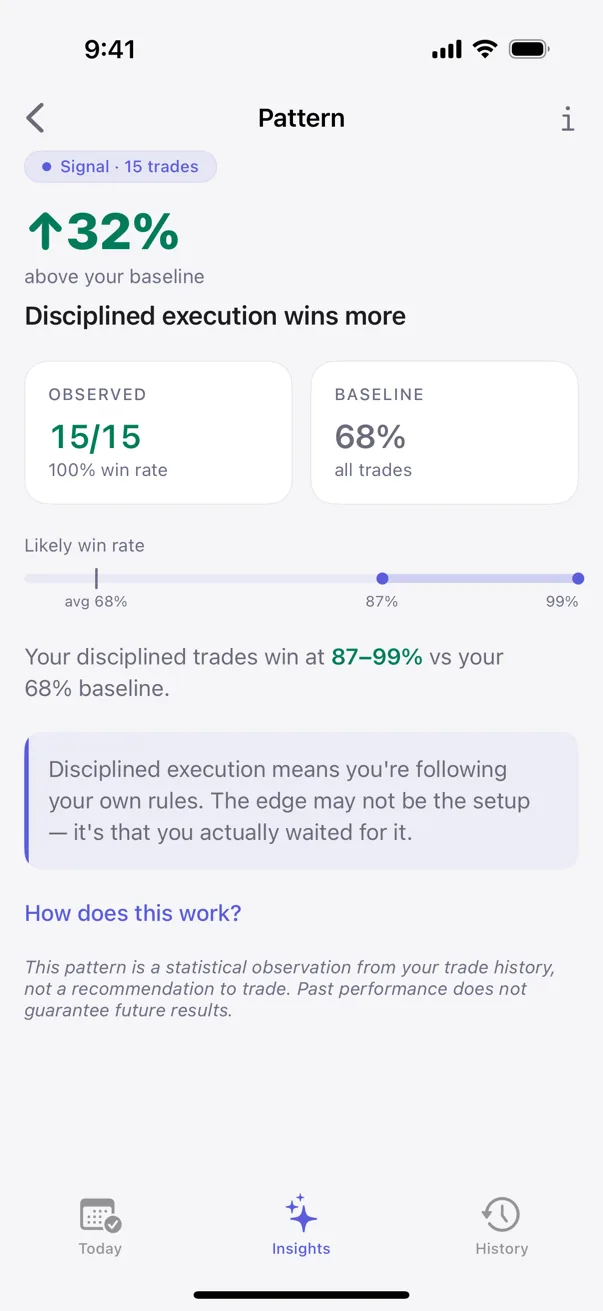
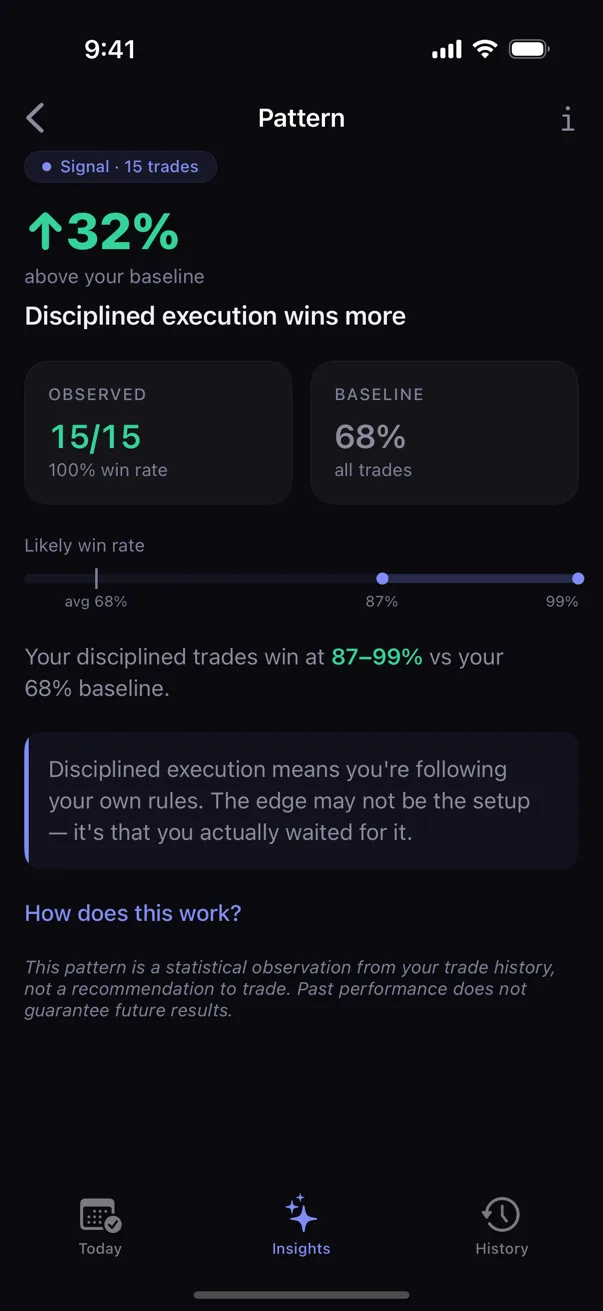
A post-loss × short-re-entry sequence is mechanically measurable when reliable timestamps and realized outcomes exist. So are size changes and differences in recorded process fields. The safe output is a comparison: what happened in the qualifying trades versus the trader's own baseline, with the sample size attached.
What that comparison cannot prove is motive. A short interval is not a diagnosis of revenge, tilt, fear, or FOMO. Those labels require context the timestamps do not contain.
Kyra today detects on-device patterns across released factors including emotion, time of day, day of week, stop-loss intent, execution rating, setup tag, position sizing, direction, exit target, and planned setup. It does not currently label short post-loss re-entry as revenge trading from timestamps alone. That deeper sequence analysis is a separate problem, and the evidence standard should stay the same if it is added later: show the qualifying trades, show the baseline, show the sample size, and do not pretend the engine can read motive.
Sources
- Kahneman, D., & Tversky, A. (1979). Prospect Theory: An Analysis of Decision under Risk. Econometrica, 47(2), 263–291.
- Coates, J. M., & Herbert, J. (2008). Endogenous steroids and financial risk taking on a London trading floor. Proceedings of the National Academy of Sciences, 105(16), 6167–6172.
- Steenbarger, B. N. (2015). Trading Psychology 2.0: From Best Practices to Best Processes. Wiley.
Educational only. Not financial or trading advice. Behavioral patterns are observations, not diagnoses of motive or mental state; outcomes vary with strategy, market conditions, and individual circumstances.