The question, and the usual answer
Search "when to enter a trade" and almost every answer is about the chart: wait for the breakout, the pullback to support, the moving-average cross, the confirmation candle. That answer is not wrong. A defined entry trigger is part of any real strategy, and trading without one is just clicking.
But it is only half the answer, and it is the half almost everyone already knows. The setup tells you when the market is ready. It says nothing about whether you are. And the second question is the one that quietly decides the outcome.
A clean setup is necessary, not sufficient
Take the same setup — the same chart, the same trigger — and hand it to the same trader on two different days. On the first, they are calm, they sized it to plan, they know where the exit is. On the second, they are down two trades and trying to get it back, they sized up to make the loss back faster, and the stop is "I'll know it when I see it." Same setup. Two different trades, and usually two different results.
The setup works
Sized to plan, exit known, no urgency. The trade is the one the strategy intended.
The same setup loses
Down two, sizing up to get it back, stop improvised. Same chart, different trade.
The variable that changed is not on the chart. It is the trader's state. This is the gap between a strategy edge and a behavioral edge: the setup is the strategy; whether you execute it as designed is the behavior. A clean setup taken in the wrong state is a losing trade wearing a winning chart.
The real entry check is you
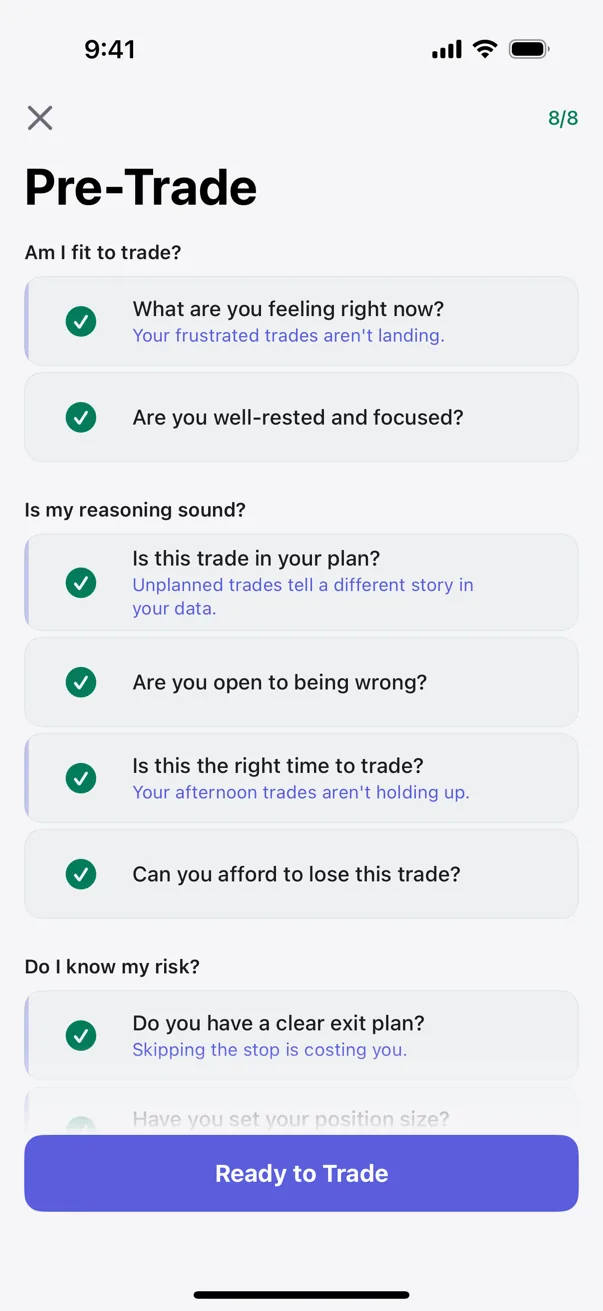
Before the setup question, there is a readiness question, and it has three parts. If any one is missing, the entry is a gamble no matter how good the chart looks.
- Emotion named.Not "managed", named. Are you calm and deliberate, or chasing a move you missed, getting one back after a loss, or riding the confidence of a streak? You do not have to feel nothing. You have to know what you feel, because the unnamed version is the one that sizes up and moves stops.
- Plan set.Entry, stop, and target defined before the click, not improvised after it. A plan made before the trade is a decision; a plan made during the trade is a reaction.
- Risk known.You know the exact amount you lose if this trade is wrong, and you sized the position to that number on purpose. If you cannot state the loss before entering, you are not managing risk; you are hoping.
None of these is about the chart. All three are about you. They are the difference between taking a trade and being taken by one.
Why a checklist beats willpower
The obvious objection: "I already know all this." Almost every trader does. The problem is not knowing the checks; it is running them under pressure, on the trade that feels urgent, when the move is happening right now and the part of the brain that does careful checks has gone quiet.
That is what a pre-trade checklist is for. It is a gate, not a vibe. It runs the same checks in the same order every time, so the decision does not depend on whether you happen to be disciplined in that exact moment — which, on the trades that cost the most, is exactly when you are not. Kyra's Pre-Trade Checklist is built around this: the checks come first, the entry comes after.
A clean setup taken in the wrong state is a losing trade wearing a winning chart.
What "not ready" looks like
Three states answer "should I enter?" with "not yet," and they are worth knowing by name because they disguise themselves as conviction:
- Just took a loss. The urge to re-enter fast to make it back is the revenge-trade sequence. The setup may be real; your reason for taking it is not.
- Watching a runner you missed. Entering late because it is still going is FOMO, and FOMO entries are reliably worse than planned ones.
- Up several in a row. A win streak quietly inflates size and loosens the plan. The most expensive trade often comes right after the best ones.
In all three, the chart can look identical to a good setup. The tell is not on the screen; it is the state you are in when you reach for the button.
The part you can't see by feel
Here is what a checklist alone cannot give you: which of these states actually costs you. Every trader's readiness profile is different. For one, the damage is concentrated in revenge entries; for another, the oversized win-streak trade; for another, the first hour of the session. You cannot introspect this reliably, because the trades you remember are not a fair sample of the trades you took.
It is measurable, though. Log each entry with the state you were in, and over enough trades the costly conditions separate from the noise — with the sample size attached, so you know how much to trust each one. Kyra detects this from your own history and turns the states that cost you into specific checklist items, so the readiness check stops being generic and becomes yours. The mechanics are in pattern detection.
So: when to enter a trade? When the setup is there and you are fit to take it — emotion named, plan set, risk known. The chart is the easy half. Run the readiness check before your next entry, and let your own data tell you which states to watch.