A plan is not a list of aspirations
"Be patient." "Respect risk." "Only take good setups." All three are reasonable advice. None is auditable.
If a rule cannot produce a yes/no answer or a measurable record after the trade, it is too vague to manage. The job of the plan is to convert intention into decisions you can inspect:
- Which setups are allowed?
- What invalidates the trade?
- How much can be risked?
- What state or condition makes you step back?
- What counts as clean execution?
- When will you review the evidence?
The six-part trading plan
1. Define the setups you are willing to trade
"A good opportunity" is not a setup. Name the structures you recognize and can review later. If the list is wide enough to include everything, it is not filtering anything.
The plan should answer: What must be present before this trade belongs to the strategy? That does not mean every setup needs to be profitable immediately. It means you can separate planned setup trades from improvisation and then compare them over a real sample.
2. Define invalidation before entry
Risk starts with the reason the trade is wrong, not with the dollar amount you hope to make. Write the condition or price that invalidates the idea before the outcome can influence it. Then size the position from that constraint rather than widening the invalidation because the preferred size was too large.
The deeper mechanics belong in a separate trading risk management plan. Here the important point is auditability: after the trade, can you see what you intended to risk and whether the exit behavior matched that intent?
3. Define the conditions that change whether you trade
A plan that only describes the chart leaves out the operator. Decide which conditions change your willingness to trade: poor readiness, unusual market hours, an emotional state you know tends to alter execution, or another constraint you can identify before entry.
Keep this concrete. "Do not trade emotionally" is not a rule. "If I am already frustrated after a loss, I pause before the next entry" is closer to one because it links a state to an action.
4. Define execution, not just entry
Many plans end when the order is opened. Real execution keeps going: size, stop behavior, scaling, exit decisions, and whether you changed the plan mid-trade. Decide which deviations matter enough to record.
This is where trading discipline becomes measurable. The question is not whether you felt disciplined. It is whether the trade followed the rules you chose while calm.
5. Define what makes you stop for the day
This does not require a universal magic number. The plan should simply name the conditions that end your participation rather than leaving the decision to the most frustrated version of you. That might be a risk limit, a sequence of rule breaks, deteriorating readiness, or another pre-decided boundary appropriate to your strategy.
A journal can document whether the boundary was respected. It cannot make the decision for you unless the trading platform itself enforces it.
6. Define the review cadence before the data exists
If you review only after a dramatic loss, the review is already biased toward the dramatic loss. Decide in advance when the plan gets inspected. Daily review is useful for completeness and recall. Weekly or sample-based review is better for asking whether repeated behavior is actually different from baseline.
For the mechanics, use a weekly trade review and keep early observations proportional to the number of trades behind them.
Turn every rule into observable evidence
| Plan rule | Evidence to preserve | Question at review |
|---|---|---|
| Trade only named setups | Setup/context on each trade | How did planned setups compare with off-plan entries? |
| Know invalidation before entry | Planned stop or invalidation context | Did exits respect the condition that made the idea wrong? |
| Keep risk within plan | Size and risk context | Where did size drift from the intended level? |
| Recognize state before entry | Emotion/readiness context | Did outcomes or execution differ in recurring states? |
| Execute cleanly | Execution and checklist context | Which deviations repeat often enough to matter? |
| Review on schedule | Complete journal over a real sample | What is stable enough to change the plan? |
A one-page trading plan template
You do not need a twelve-page document. Start with one page you can audit:
- SetupsI trade: [named setups]. I pass when the structure is outside this list.
- InvalidationBefore entry, I define what makes the idea wrong and where that is observable.
- RiskI size from the invalidation and my risk rule, not from the profit I want.
- ReadinessIf [specific state or condition] is present, I take [pre-decided action].
- ExecutionI record meaningful deviations from the planned setup, size, stop, and exit process.
- Daily stopI stop participating when [pre-decided boundary] is reached.
- ReviewI check completeness daily and review repeated behavior on [fixed cadence].
The blanks matter more than the prose. A plan becomes real when it contains conditions you can identify before the trade and verify after it.
How Kyra can support an auditable plan
Kyra does not contain a customizable trading-plan builder, and it does not block you from breaking your rules. What it can do is preserve evidence around the decisions you made: setup and emotion context, execution quality, optional stop-price information, checklist answers, the resulting trade, and the longer history those records become part of.
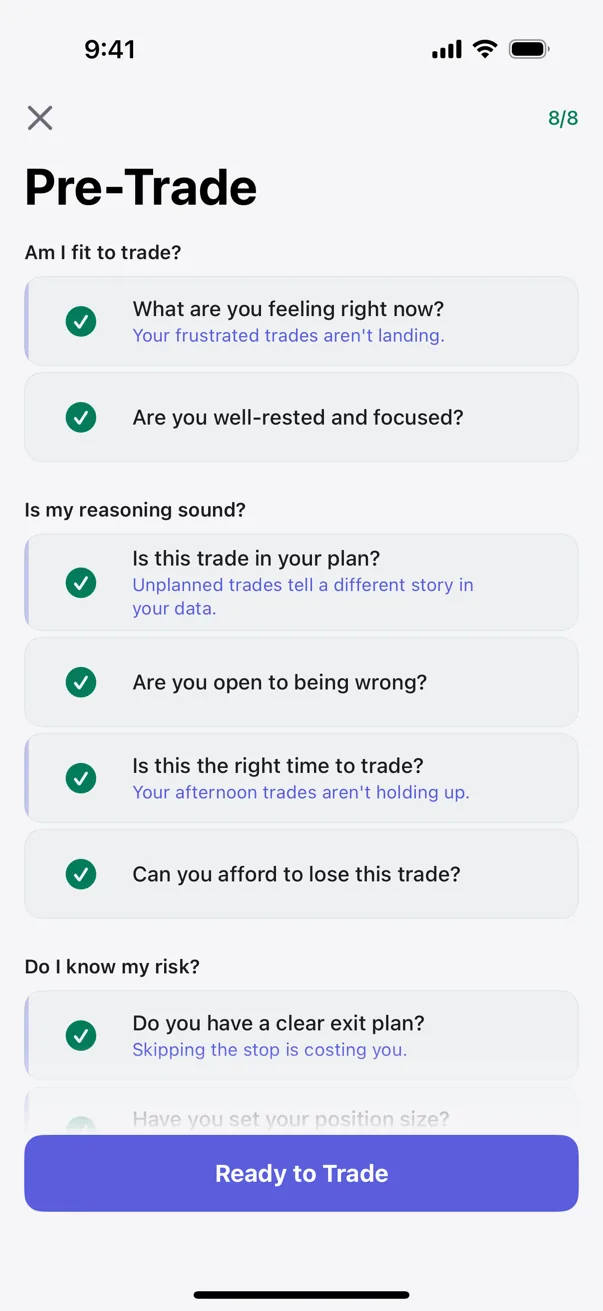
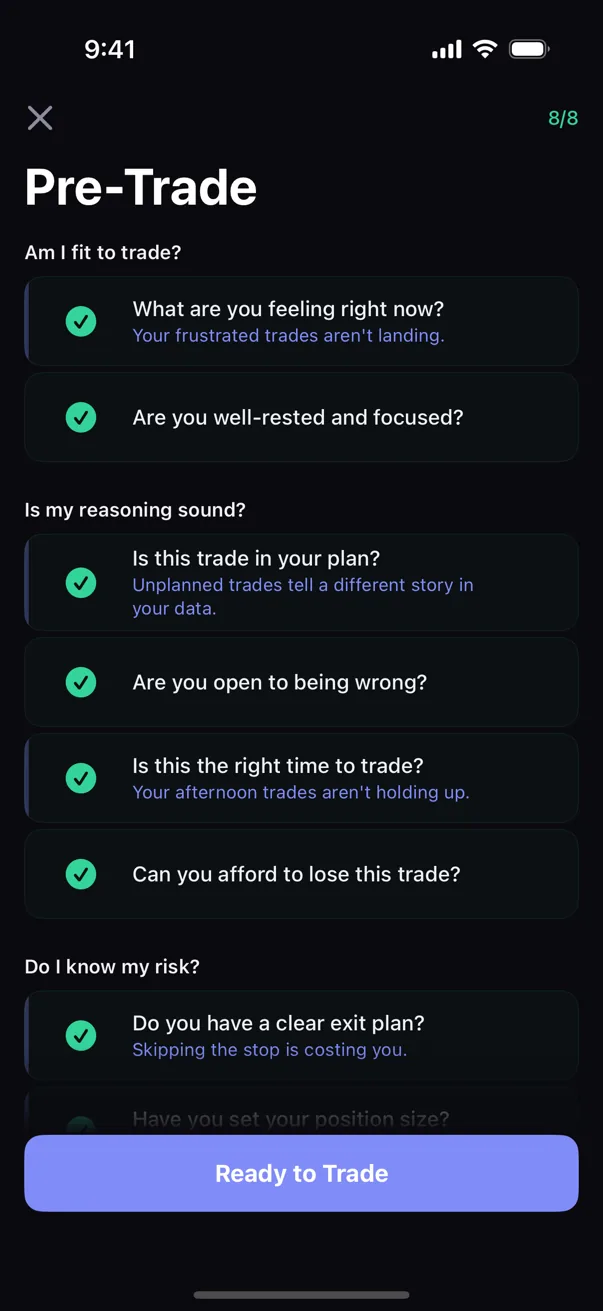
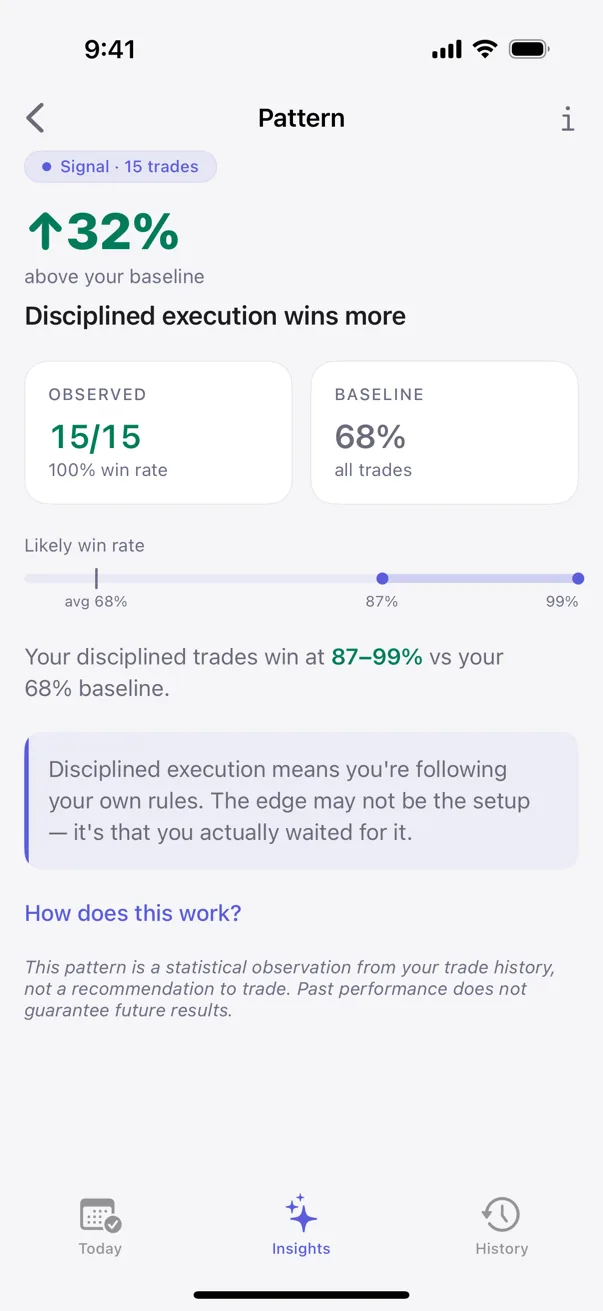
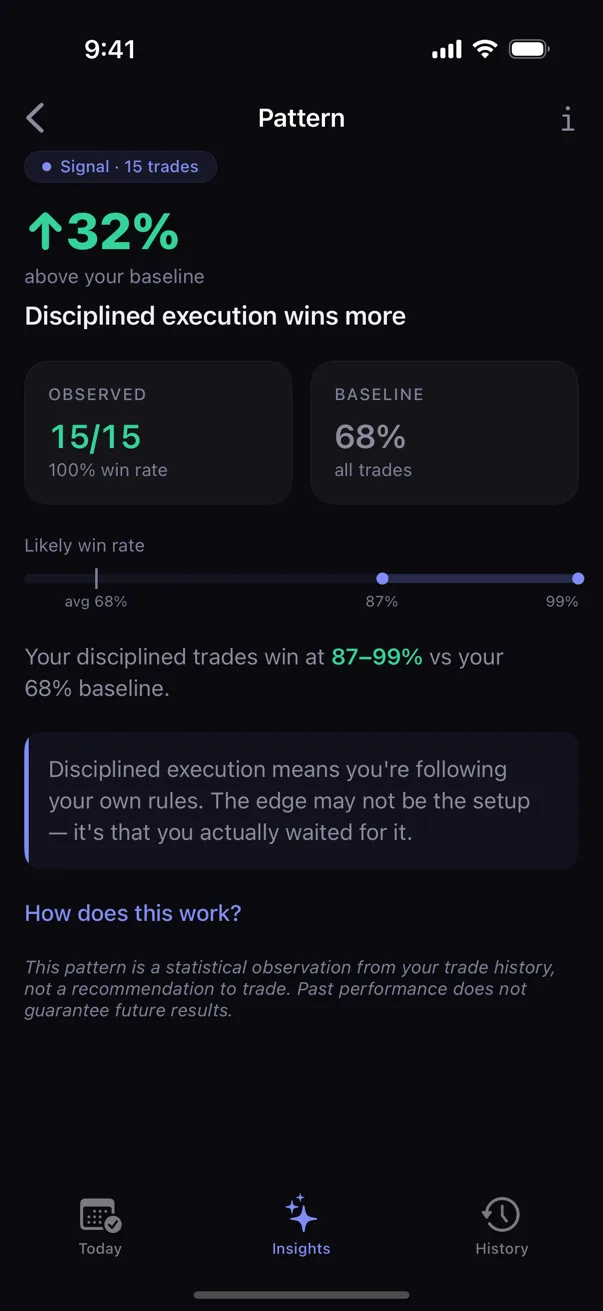
After the trade, the journal record gives those decisions somewhere to land. Over time, Insights can surface observations across factors such as setup, timing, planning, position sizing, emotion, and execution. Each observation still needs enough relevant trades behind it before it deserves weight.
What not to put in the plan
Three things make plans impressive on paper and weak in practice:
- Outcome targets presented as behavior. "Make $500 today" does not tell you what action is valid on the next trade.
- Rules you cannot observe. "Be patient" has no audit trail until you define what patient behavior looks like.
- Rules added after every loss. A plan that changes after each painful outcome becomes a diary of recent emotions rather than an operating system.
Change the plan when the evidence warrants it, not when one trade hurts enough to demand a new rule.
The test: could someone audit this without reading your mind?
Read every rule and ask one question: what would I need to see in the journal later to know whether this happened?
If there is no observable answer, rewrite the rule. If the evidence exists but you never record it, simplify the journal until you do. If the rule changes every week, give the sample more time before you call the change an improvement.
That is the difference between a trading plan that sounds disciplined and one that can actually be tested.
Educational only. Not financial or trading advice. A trading plan can structure decisions and review, but it cannot eliminate losses, guarantee execution, or make a strategy profitable.