Why P&L is the wrong lens
The first thing almost everyone does in a trade review is total the week's profit and loss. It is the most available number, the one the broker hands you, and the one that feels like the verdict. It is also the one that tells you the least about whether you traded well.
The problem is that outcome and process are not the same thing, and over a single week they barely correlate. A trade can be entered for all the right reasons — the setup was clean, the size fit the risk, the stop was where the chart said it should go — and still lose, because the market does not owe a good decision a good outcome. The reverse is just as true: a trade entered on a whim, oversized, with the stop yanked wider mid-trade, can win. Across one week, variance is loud enough to drown out skill entirely.
So a winning week can be full of bad decisions you got paid for, and a losing week can be full of good decisions the market did not reward this time. If the only thing you review is the P&L, you will learn exactly the wrong lesson from both. You will reinforce the lucky bad habit and abandon the disciplined process that was working. The scoreboard is real, but it is feedback on the market, not feedback on you.
Two lenses
There are two ways to look at the same week of trades. One is the lens almost everyone defaults to. The other is the one that actually changes what you do next week.
The scoreboard lens
Total P&L, win rate, biggest winner, biggest loser. It answers "did I make money?" — a question the market mostly decided. Over one week it is dominated by variance, so it tells you almost nothing repeatable about your own decisions.
The behavior lens
Setup quality, plan-adherence, emotion tags, position sizing, time-of-day. It answers "did I trade the way I meant to?" — a question entirely within your control. These are the inputs you can actually adjust, and they are stable enough to read week over week.
The behavior lens is the useful one because every item in it is something you decided, not something the market handed you. You cannot control whether a clean breakout follows through. You can control whether you took the trade at your planned size, with your planned stop, in the window where you trade best. Review the inputs you own, and the review becomes actionable instead of merely descriptive.
What to actually review
Reading by behavior means slicing the week along the dimensions you control and asking which slice is quietly costing you. Four cuts do most of the work:
- By setup — Group the week's trades by the setup that triggered them: breakout, dip buy, reversal, gap fill, scalp. Which setups are you actually executing well, and which one keeps showing up in your losers? Often one familiar setup is carrying the week and another is bleeding it.
- By emotion — Tag the felt state at entry: calm, focused, FOMO, frustrated. The trades taken from a clean headspace and the trades taken to chase or to get even tend to separate sharply once you have a few weeks of tags. The emotion column is where most of the avoidable damage hides.
- By plan-adherence — For each trade, a binary: did this match a setup I had planned, sized the way I intended, or did I improvise? Improvised trades are not automatically losers, but they are the ones worth counting, because they are the ones you can choose to stop taking.
- By time-of-day — Bucket entries by hour or by session segment. Many traders have a window where their edge is real and a window where they are just filling time. The first hour and the lunch lull rarely perform alike, and the timestamps make that visible without any guessing.
None of these requires a spreadsheet wizard. Each is a question you can answer by sorting the week's trades one way and reading down the column.
The weekly cadence
A review only changes behavior if it happens — reliably, on a schedule, whether the week was green or red. The point of fixing a cadence is to remove the decision about whether to review, the same way a pre-set position size removes the decision about how big to go. Pick one time each week — Friday after the close, Sunday evening before the open — and make it the ritual. The same time every week is what turns it from an intention into a habit.
The reason this matters is that review is the feedback loop, and without a feedback loop, repetition does not become skill. Ericsson's work on deliberate practice [1] draws exactly this line: it is not raw hours that build expertise, but structured, feedback-driven repetition aimed at a specific weakness. Trades without review are reps without feedback — volume that entrenches whatever you already do, good or bad. The weekly review is what converts a pile of trades into a practice.
1. Pull the week's trades
Gather every trade you closed this week in one place. Not a mental highlight reel of the memorable ones — the full set, winners and losers alike, because the forgettable trades are usually where the pattern lives.
2. Group by behavior, not P&L
Sort by setup, by emotion, by plan-adherence, by time-of-day — the four cuts above. Resist the urge to sort by size of win or loss. You are looking for what you did, not what you were paid, and those are different sorts.
3. Find the one pattern worth changing
Pick a single behavior that cost you — the improvised mid-day reversals, the oversized entries after a loss, the FOMO chases in the first ten minutes. One. A review that produces a list of ten things to fix produces zero things fixed. If you want a concrete read on what a leak is actually costing, run a few of the week's losers through the P&L calculator to size the bleed in dollars rather than vibes.
4. Write one rule and carry it forward
Turn the pattern into a single, testable rule for next week: "no reversals before 11am," "size stays fixed regardless of the prior trade." Write it where you'll see it before the open. Next week's review starts by checking whether you held the rule — and the loop closes.
The four questions that matter
If the slicing feels like a lot, the whole review collapses into four questions. Answer these honestly and you have done the work:
- Which behavior cost the most this week? Not which trade — which behavior. The single repeated decision, across several trades, that did the most damage.
- Did I follow my plan? Across the week, what fraction of entries matched a setup I had defined and sized as intended? The honest number is usually lower than the remembered one.
- What was my marginal trade? The weakest trade I still talked myself into — the one at the edge of my rules. That trade marks where the line actually sits, as opposed to where I claim it sits.
- What one change carries to next week? The single rule from the cadence above. If nothing carries forward, the review was reading, not practice.
These four are the spine of process-focused review that Steenbarger frames as the shift from grading outcomes to grading the quality of your decisions [2] — best processes over best results. The scoreboard answers none of them. Your own behavior answers all four.
Turning review into a system
The honest obstacle to all of this is that reading your own trades by behavior is tedious, and tedious things get skipped. Sorting a week by emotion and plan-adherence by hand, every week, is exactly the chore that quietly lapses after a month. The fix is to make the behavioral cuts the thing the journal hands you, so the review becomes reading evidence rather than reconstructing it.
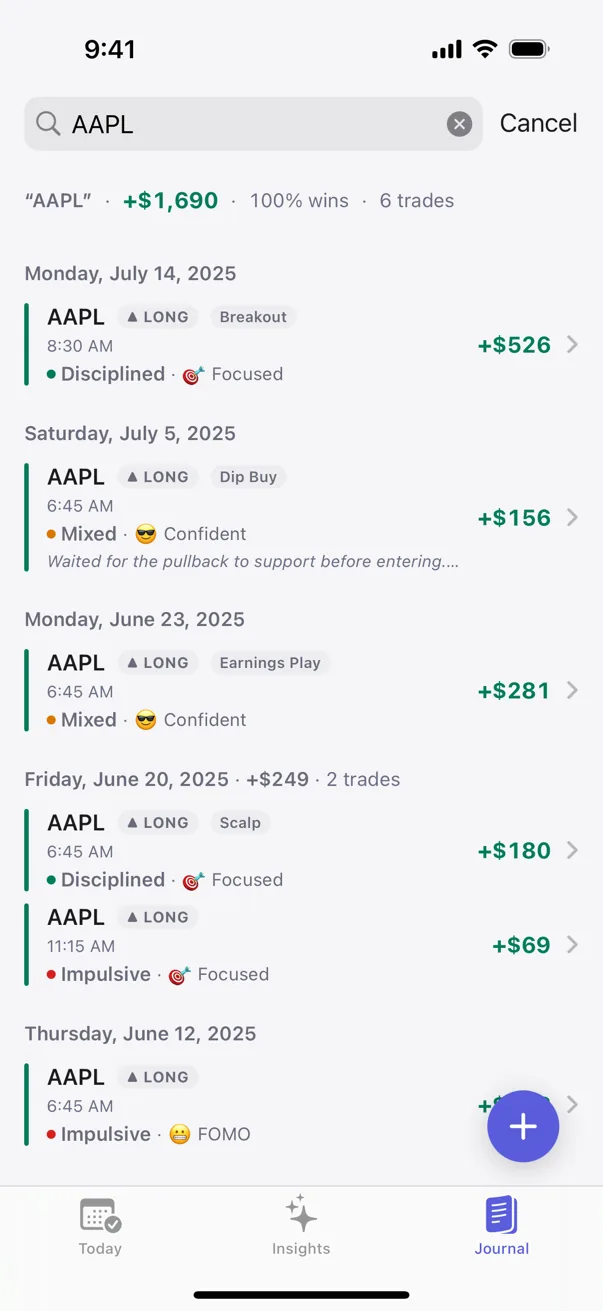
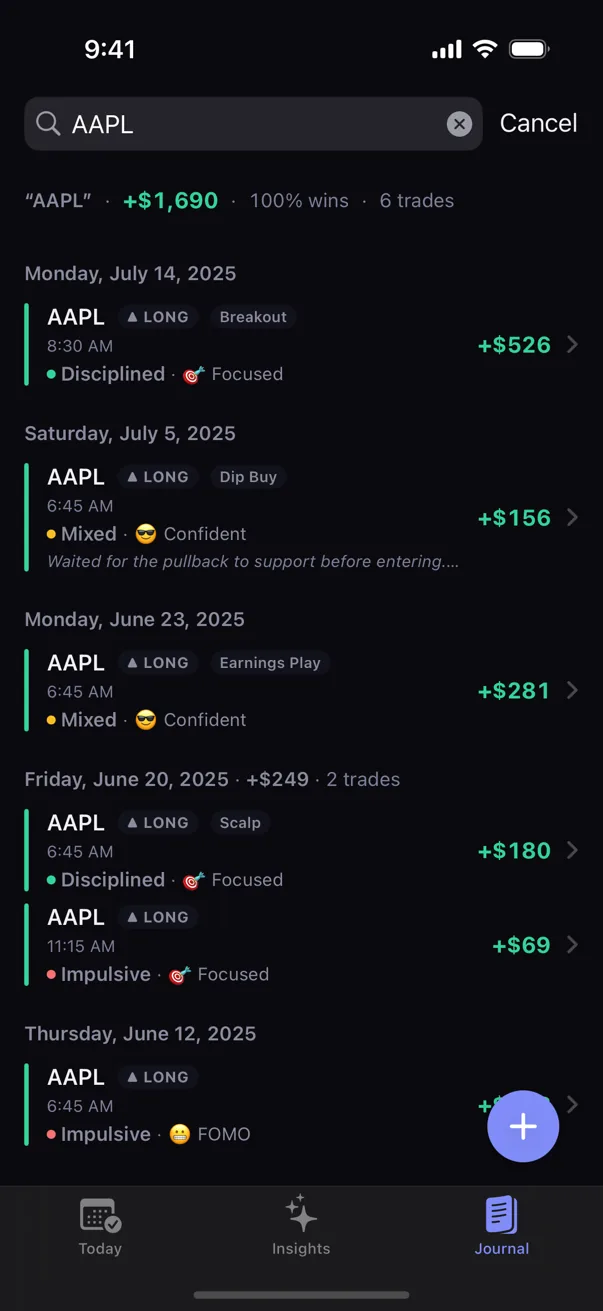
That is the substrate Kyra is built to be. The Journal holds the full set of trades, already tagged with emotion, setup, plan-adherence, and timing — the four cuts, pre-sorted. The Insights surface runs statistical tests across that history and reports back the behaviors that move your results, with a tier on each one — Tracking, Emerging, Developing, Established — that tells you how much weight the evidence can bear so far. The weekly review stops being a guess about which habit hurt and becomes a read of which pattern the data has actually surfaced. To pressure-test whether a leak you spotted is worth a rule, the risk/reward calculator lets you sanity-check the trade geometry behind it before you commit the change.
Kyra Trading is a private trading journal that does this on-device. Pattern detection runs locally with a statistical engine that tests observations against chance, and every pattern surface carries its sample size and a confidence range, so you can see exactly how much a signal is worth before you act on it. There are no accounts and no servers — nothing leaves the device. Your trades, and the patterns inside them, stay yours.
Sources
- Ericsson, K. A., Krampe, R. T., & Tesch-Römer, C. (1993). The Role of Deliberate Practice in the Acquisition of Expert Performance. Psychological Review, 100(3), 363–406.
- Steenbarger, B. N. (2015). Trading Psychology 2.0: From Best Practices to Best Processes. Wiley.
Educational only. Not financial or trading advice. The review practices described above draw on the published literature on deliberate practice and trading process; specific outcomes vary with strategy, market conditions, and individual circumstances.