The routine everyone pictures
Ask what a pre-market routine looks like and you'll hear the same list: check the futures, read the overnight headlines, mark support and resistance, build a watchlist. None of that is wrong. It's preparation about the market — what it might do — and a serious trader needs some of it.
But it has two failure modes. The first is that it's bottomless: there's always one more ticker, one more headline, one more level, and the scan quietly becomes a way to feel busy without deciding anything. The second is that it leaves out the variable that actually predicts how your morning goes — you. The same watchlist, traded by a rested and a frayed version of the same person, produces two different days. The market half of the routine can't see that. The shorter, more useful routine can.
The three checks that change behavior
A routine that moves your results is built from three questions, in order. Each takes a moment, and each is about the conditions you actually control going into the session.
1. Where is the market in its session?
Not the price — the phase. Pre-market and after-hours run on thin liquidity and wide spreads; the open is the most volatile stretch of the day; a holiday or half-day changes everything. Knowing which one you're walking into sets the right expectations before you've placed a thing. A breakout in the first five minutes and the same breakout at lunch are not the same trade, and most of the cost of trading outside the regular session comes from forgetting that the venue changed.
2. What's your edge today?
Before you go looking for setups, name the one you actually have. Your edge is the setup, state, or window where your own history says you run above your baseline — the thing worth leaning on. Leading with it does two jobs: it gives the session a focus, and it crowds out the marginal trades you take when you have no plan and the screen is on. A routine that starts with "here's my edge" ends with fewer "might as well" entries.
3. Are you fit to trade?
The last check is the one most routines skip, and it's the one that pays. A clean setup still needs a clear head; the question of when to enter is at least as much about the trader as the chart. Name your state honestly — rested or short on sleep, calm or already wound up — and decide your risk before the open, because a fresh mind is a better risk manager than a depleted one. Self-control draws on a limited reserve that the day will spend [2]; the size and stop you set at 9:00 are wiser than the ones you'll improvise at 9:45.
Decide the checks in advance — that's the point
The reason to make this a routine rather than good intentions is that intentions evaporate under pressure and pre-set plans don't. The cleanest finding in the self-regulation literature is that linking a situation to a specific, pre-decided response — an "if this, then that" plan — dramatically improves follow-through, because the response fires almost automatically when the moment arrives [1]. "If the setup isn't on my plan, I don't take it." "If I'm short on sleep, I trade half size." Those decisions are easy to make the night before and nearly impossible to make well in the first volatile minutes.
Keep it short, or you won't do it
A five-minute routine you run every day beats a thirty-minute one you abandon by Wednesday. The marginal value is not in the fiftieth ticker; it's in the three checks above and the pre-committed rules that fall out of them. Set your position size for the day's conditions before the bell, and the routine has already done its most important work — the size is decided while you're still calm enough to decide it well.
- Read the sessionPre-market, the open, regular hours, or a closed/short day — set expectations for the venue you're entering.
- Name your edgeThe one setup or window your own history favors. Lead with it; let it crowd out the marginal trades.
- Check your readinessState named, risk set. A fresh mind is the better risk manager — so set the size now, not at 9:45.
- Pre-commit the rules"If the setup isn't planned, I pass." "If I'm tired, I halve size." Decided before the bell, not during it.
Doing it without the ritual
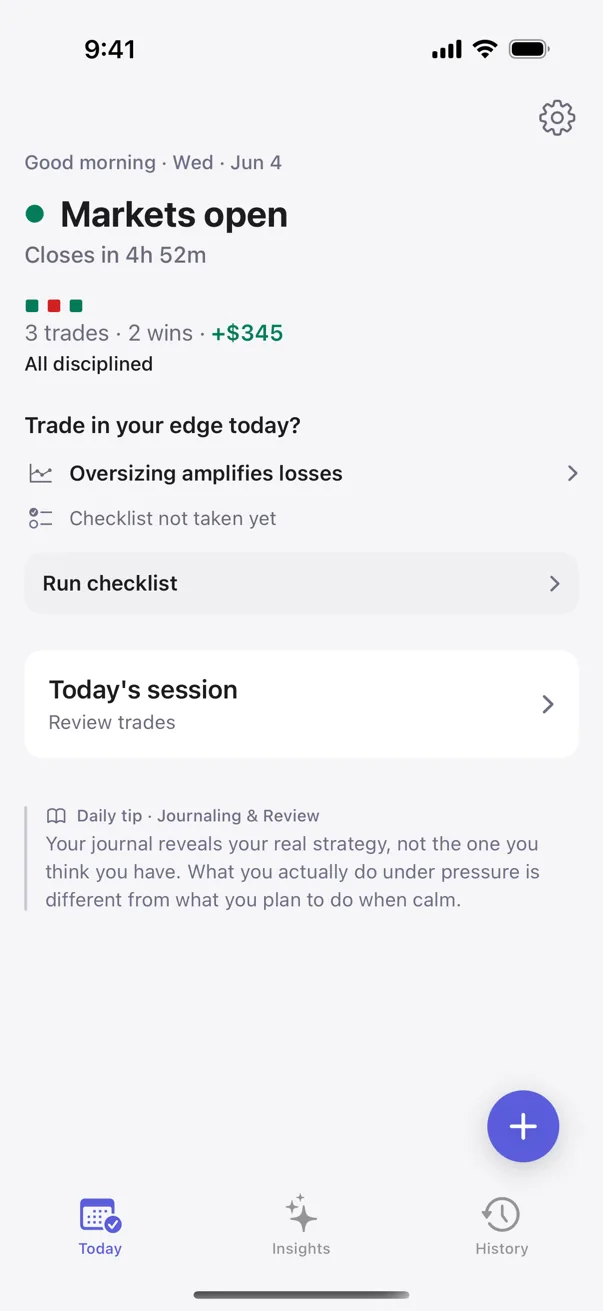
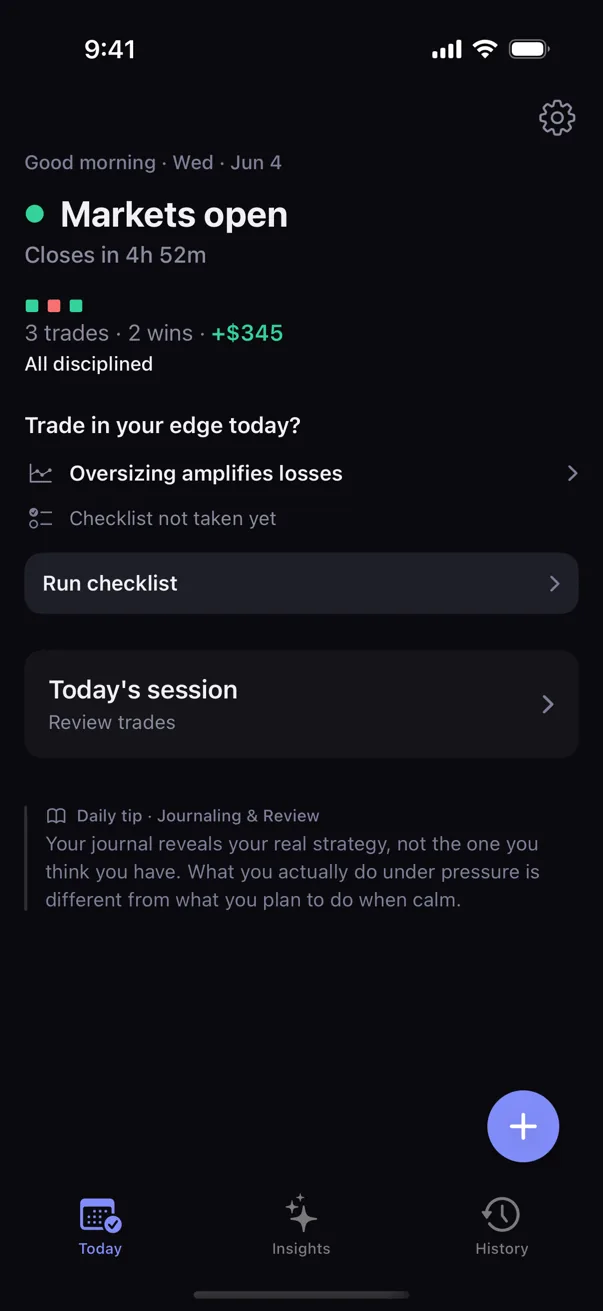
This is the shape of Kyra's Today tab, which opens to exactly these three things and nothing you don't need: where the market is in its session, your strongest edge for the day, and a readiness read — not a profit-and-loss scoreboard that just tells you whether yesterday was good. The adaptive pre-trade checklist turns the readiness step into a few concrete pre-commitments, drawn from the patterns your own trades have surfaced. The routine stays short because the app holds the parts you'd otherwise have to remember.
Sources
- Gollwitzer, P. M. (1999). Implementation intentions: Strong effects of simple plans. American Psychologist, 54(7), 493–503.
- Baumeister, R. F., Bratslavsky, E., Muraven, M., & Tice, D. M. (1998). Ego depletion: Is the active self a limited resource? Journal of Personality and Social Psychology, 74(5), 1252–1265.
Educational only. Not financial or trading advice. Behavioral mechanisms described above are observations from the published literature; specific outcomes vary with strategy, market conditions, and individual circumstances.