Same ticker, different market
Extended hours — the pre-market session before the open and the after-hours session after the close — looks like normal trading. Same ticker, same chart, same order ticket. Underneath, it's a structurally different venue: a fraction of the volume, far fewer participants, and a bid-ask spread that can be several times wider than what you're used to during the regular session. The depth that quietly absorbs your order at midday isn't there. A single order can move the price in a way it never would when the full crowd is present.
That difference isn't a nuance. It changes the price you get, the risk you actually carry, and the reliability of the protections you think are in place. Most of the trouble with extended-hours trading comes from treating it like the regular session with a different clock, when it's really a different game.
What the microstructure research says
This isn't folklore; it's been measured. A study of trading across the full 24-hour day found that after hours, volume is low, prices are noticeably less efficient per hour, and price moves are more volatile [1]. The thin book is the mechanism: with few orders resting, each trade carries more weight and pushes price further. Your fill comes at a worse price, your slippage is larger, and the market is jumpier per unit of real information.
For a trader, the translation is concrete. The spread you cross is a cost, and after hours that cost is bigger on every entry and every exit. The level you're leaning on can be skipped entirely when the next print arrives from a single order. And a stop is far less dependable when there isn't enough resting liquidity to fill it near your price — it can slip badly or jump a level that simply wasn't there.
Gaps and headline risk
The other hazard of trading around the edges of the session is that the biggest news lands there. Earnings, guidance, and macro releases routinely hit pre-market or just after the close, dropping into the thinnest part of the tape. The result is gaps: the price you modeled and the price you actually trade are not the same number, and the distance between them can be violent.
That breaks risk planning in a specific way. A stop assumes you can exit near a chosen level; an overnight or post-earnings gap means the next available price can be well past it, so your real loss is set by where the gap opens, not where your stop sat. Position sizing done against the regular-session range understates the risk when the instrument can move several percent between two prints. When the spread widens and a gap is in play, your risk/reward math is quietly distorted — the "R" you planned is not the "R" you're taking.
The behavioral pull — why you're even there
Here's the part worth being honest about. For most retail traders, extended-hours activity isn't a planned strategy. It's the inability to stop. The session ended badly and you want it back before tomorrow — that's revenge, after the bell. A name is running on a headline and you can't stand to miss it — that's FOMO, in thin liquidity. Or the day is over, the screen is still on, and boredom finds something to do.
None of those are edges. They're the same behavioral leaks that cost during the day, except now they're operating in the worst possible conditions — wide spreads, gaps, no crowd to bail you out. The honest question to ask before any extended-hours trade is whether this is a deliberate strategy you'd take in daylight, or whether you're trading because you couldn't log off. If it's the latter, the problem isn't the setup; it's that you're still at the desk. Overtrading after hours is just overtrading with the safety rails removed.
The fingerprint in your log
Like every behavioral pattern, this one leaves a trace. Every trade already carries the time it was entered, which sorts cleanly into pre-market, the regular session, and after-hours. Bin your outcomes by those windows and the extended-hours buckets often tell on themselves — lower win rate, worse expectancy, and a cluster of impulsive entries that the regular session doesn't show.
This is a different cut from the within-session time-of-day curve, which tracks how your judgment drifts during the regular session as decision fatigue sets in. Here the line is drawn between regular hours and extended hours — a question of venue and impulse rather than fatigue. The two can both be true at once, and both live in your timestamps.
How to use it
1. Size for the spread, not the chart
If you do trade extended hours deliberately, size to the conditions, not to the regular-session range. A wider spread and gap risk mean a smaller position carries the same real risk. Set the size against the worse case before you enter — a pre-committed position size keeps the thin-market trade from quietly becoming your largest.
2. Use limit orders
A market order in a thin book is how you donate to whoever's resting on the other side. Limits protect you from the worst of the spread and from a single print running away with your fill. The convenience of a market order is never worth what the after-hours book charges for it.
3. Separate strategy from compulsion
Before the trade, name the reason. If it's a planned extended-hours edge, fine — take it with the sizing and order discipline above. If the only reason you're trading after the bell is that the day didn't go your way or a name is running without you, that's a behavioral flag, not a setup. The most profitable extended-hours decision is usually to close the laptop.
Measuring it
The reason the extended-hours leak is hard to fix from memory is the reason it's tractable from data: you remember the one after-hours trade that paid, not the slow bleed of bad fills and impulsive entries that decides the average. Your timestamps don't have that bias. Every trade records when it was entered, and binning outcomes by session window turns "I think I trade worse after the close" into a number with a sample size behind it.
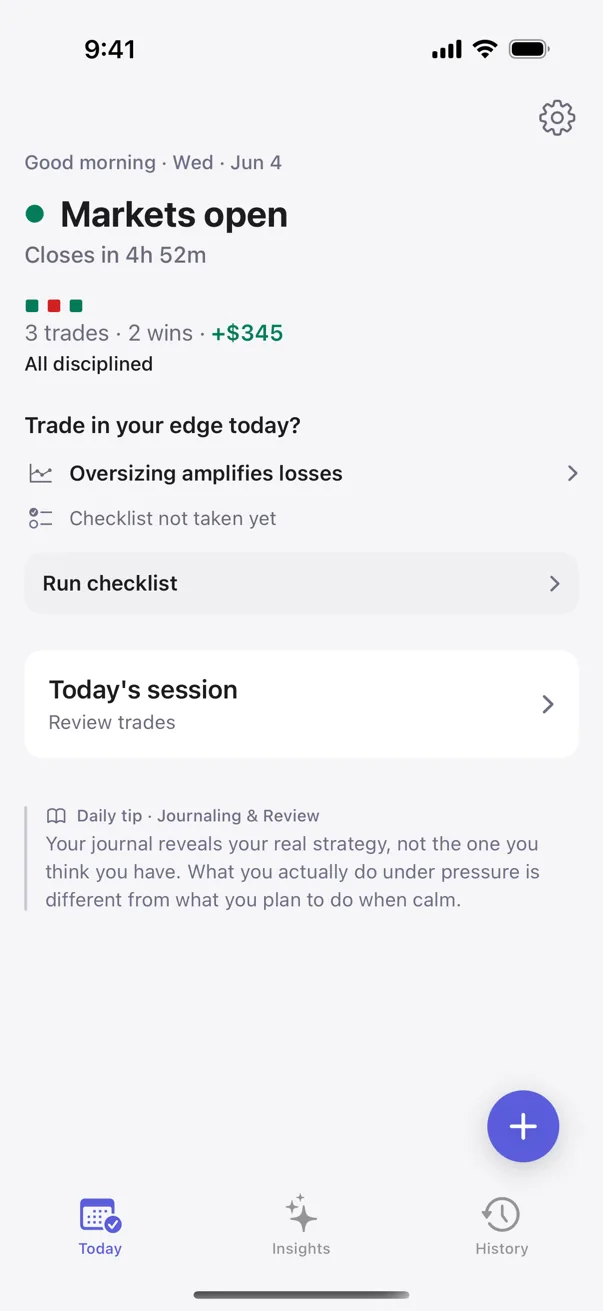
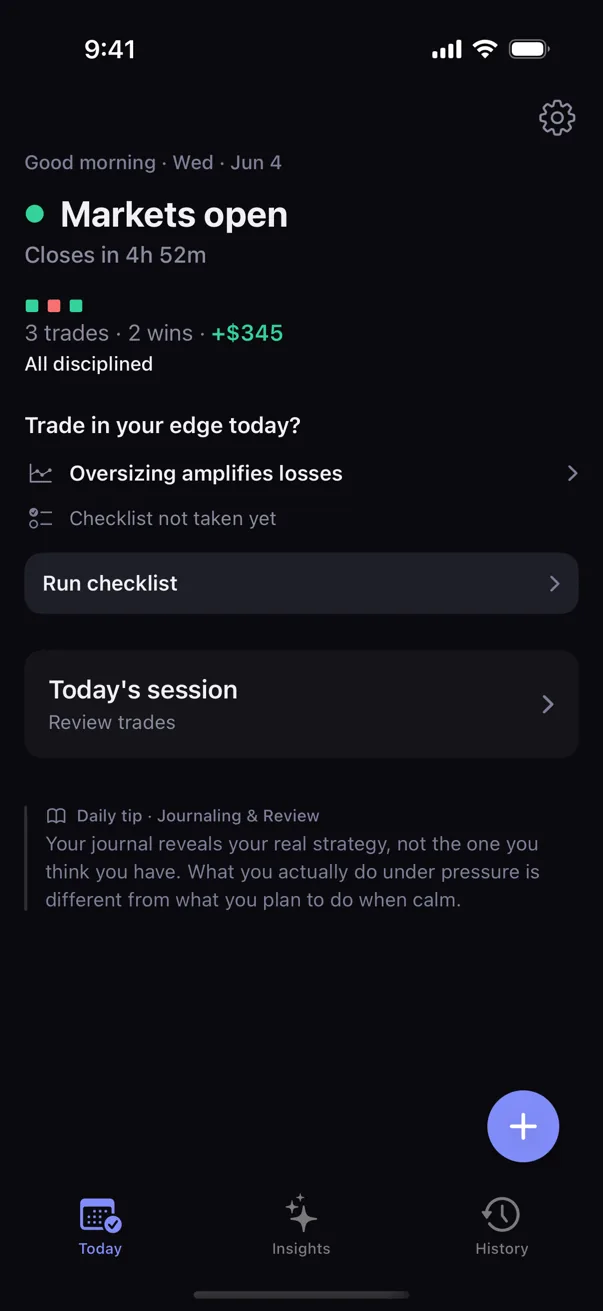
This is what behavioral pattern detection measures. Kyra bins your outcomes by time of day, including the pre-market and after-hours windows, and surfaces when one of those windows runs below your baseline — and because it also reads the emotion and execution you logged, it can show whether your after-hours trades are also your most impulsive. The output isn't a generic "don't trade after hours" tip. It's a measurement: the trades you entered in this window returned X relative to your baseline, with an uncertainty range that tightens as the sample grows.
Kyra Trading is a private trading journal that does this detection on-device. Its statistical engine tests each candidate pattern against chance and labels it by how much data stands behind it — Tracking, Emerging, Developing, or Established — so a time-of-day signal earns trust only as the evidence accumulates. Every pattern surface includes the sample size and an uncertainty range. Nothing leaves the device. Pattern detection runs locally, no accounts, no servers. The trader's data stays the trader's data.
Sources
- Barclay, M. J., & Hendershott, T. (2003). Price discovery and trading after hours. The Review of Financial Studies, 16(4), 1041–1073.
Educational only. Not financial or trading advice. Market-structure and behavioral observations above are drawn from the published literature; specific outcomes vary with instrument, venue, market conditions, and individual circumstances.