The goal is a comparable record, not a diary
Most "track your emotions" advice pictures a journal full of paragraphs about how a trade felt. That's expressive, and it's nearly useless for finding patterns. Prose can't be compared across two hundred trades; you can't ask a pile of sentences "what's my win rate when I'm anxious." The point of tracking emotion is to turn a feeling into a data point you can line up against an outcome — and that requires structure, not eloquence.
So the practice is narrow on purpose: attach one state to each trade, from a small fixed set, and move on. The discipline is in the consistency, not the detail. Why the emotional state is worth tracking at all — the mechanisms by which it moves your results — is covered in how emotions affect trading performance. This piece is about the how.
Track the state, not a story
Pick a fixed vocabulary of states and reuse it every time — something like calm, focused, anxious, frustrated, hyped. The exact list matters less than the fact that it never changes. "Frustrated" has to mean the same thing on trade 5 and trade 205, or you can't compare the two. A consistent label is what lets a pattern surface; a fresh adjective every time is just decoration.
This is also why a one-to-ten "mood score" underperforms. A number feels measurable, but "my anxiety was a 6" doesn't map to anything you can act on, and the scale drifts with your day. A named state is coarser and far more useful: it sorts cleanly, and the sorting is the whole game.
Tag in the moment, not at review
Log the state when you take or close the trade, while it's still true. Reconstructing your mood at the end of the week is fiction — you don't have access to the anxious version of yourself anymore, and your memory will hand you a tidy story instead. The bias is well documented: we judge how we felt by how easily a vivid moment comes to mind [1], which means a reconstructed log is built from your three most dramatic trades, not your forty representative ones. Tag at the moment, even roughly, and the record stays honest.
The mistake that ruins the data: self-diagnosis
Here is the one that quietly wrecks most emotion tracking. Don't log a verdict — "this was a FOMO entry," "that was a revenge trade." Log the state — anxious, hyped, frustrated. The difference looks small and is enormous.
A verdict asks you to diagnose yourself in the worst possible moment, and people are bad at it even in calm ones. The classic finding is that we have poor access to the real causes of our own behavior — asked why we did something, we confidently report reasons that demonstrably weren't the cause [2]. A trader who just took a loss will either over-label everything "revenge" or skip the tag and call it clean. Either way the "analysis" downstream runs on data you falsified to yourself at entry.
Record the neutral state and let the measurement decide whether it was costing you. That's the move that keeps the dataset clean — and it's the same principle behind what "AI" should mean in a trading journal: detected, not self-diagnosed.
Let the numbers find your most expensive feeling
Once you have a tagged history, the analysis is simple: group your trades by state and compare outcomes. The states where your win rate or expectancy sags below your baseline are your most expensive feelings — and they're usually not the ones you'd have guessed.
Put a dollar figure on it and the motivation gets concrete: tally the trades taken in your worst state with a P&L calculator and you'll usually find a single feeling is quietly funding the rest of your account's bad days. That's the number worth acting on — and it only exists because you tagged the state in the moment and never tried to diagnose it.
The practice, in four steps
- Fix your vocabularyA short, unchanging list of states. Reuse it on every trade so the labels stay comparable.
- Tag one state per trade, in the momentAt entry or close, while it's accurate. Rough and honest beats precise and reconstructed.
- Never self-diagnoseRecord the feeling, not the verdict. "Anxious," not "this was revenge." Let the data assign the cause.
- Review by state after a real sampleOnce you have enough trades, compare outcomes per state. The gap is your most expensive feeling.
Doing it without the spreadsheet
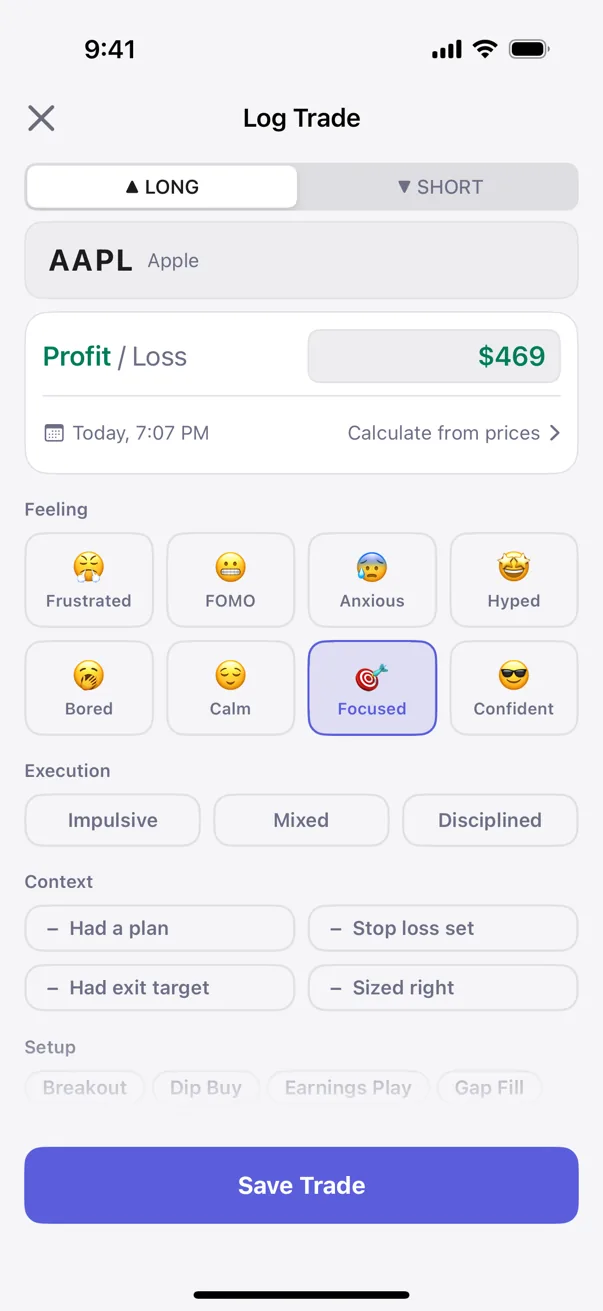
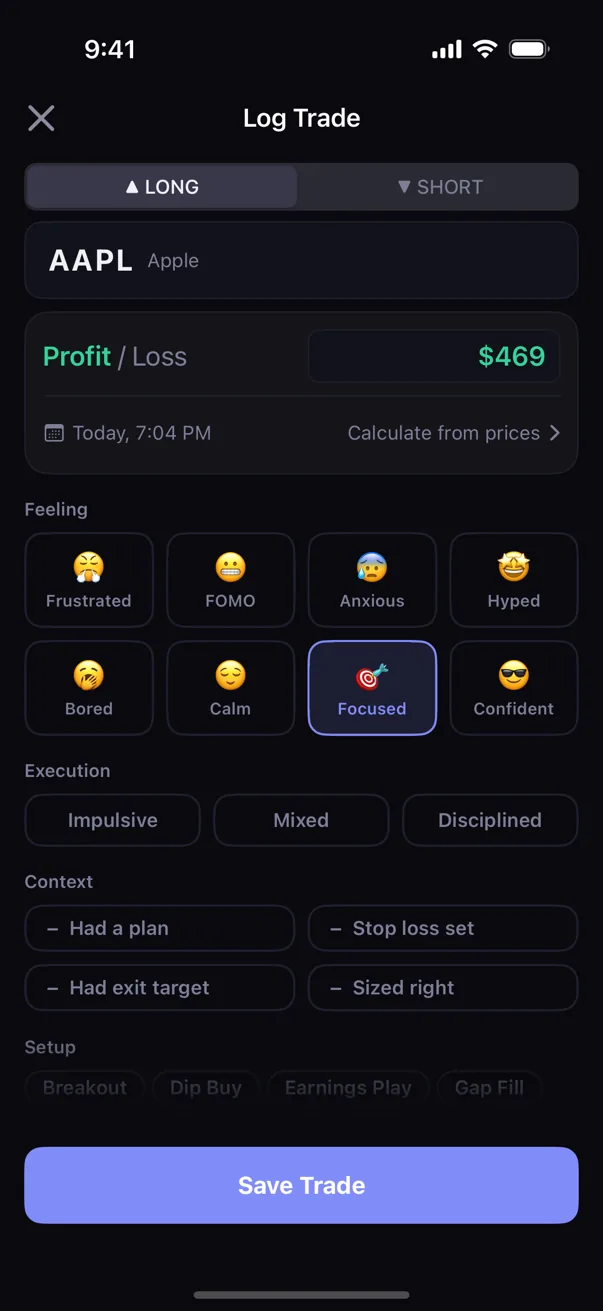
This is exactly what Kyra is built to do. You tap one neutral state when you log a trade — no free text, no slider, no "rate your mood" — and the app keeps the rest of the practice for you: it compares your outcomes across states and surfaces the ones that move your win rate, each with the number of trades behind it and an uncertainty range that narrows as your history grows. You never tag a verdict; the statistics assign the cause. The analysis runs on-device and there is no Kyra account. The full picture of how the detection works is in the trading emotion tracker and pattern detection.
Sources
- Tversky, A., & Kahneman, D. (1973). Availability: A heuristic for judging frequency and probability. Cognitive Psychology, 5(2), 207–232.
- Nisbett, R. E., & Wilson, T. D. (1977). Telling more than we can know: Verbal reports on mental processes. Psychological Review, 84(3), 231–259.
Educational only. Not financial or trading advice. Behavioral mechanisms described above are observations from the published literature; specific outcomes vary with individual circumstances.