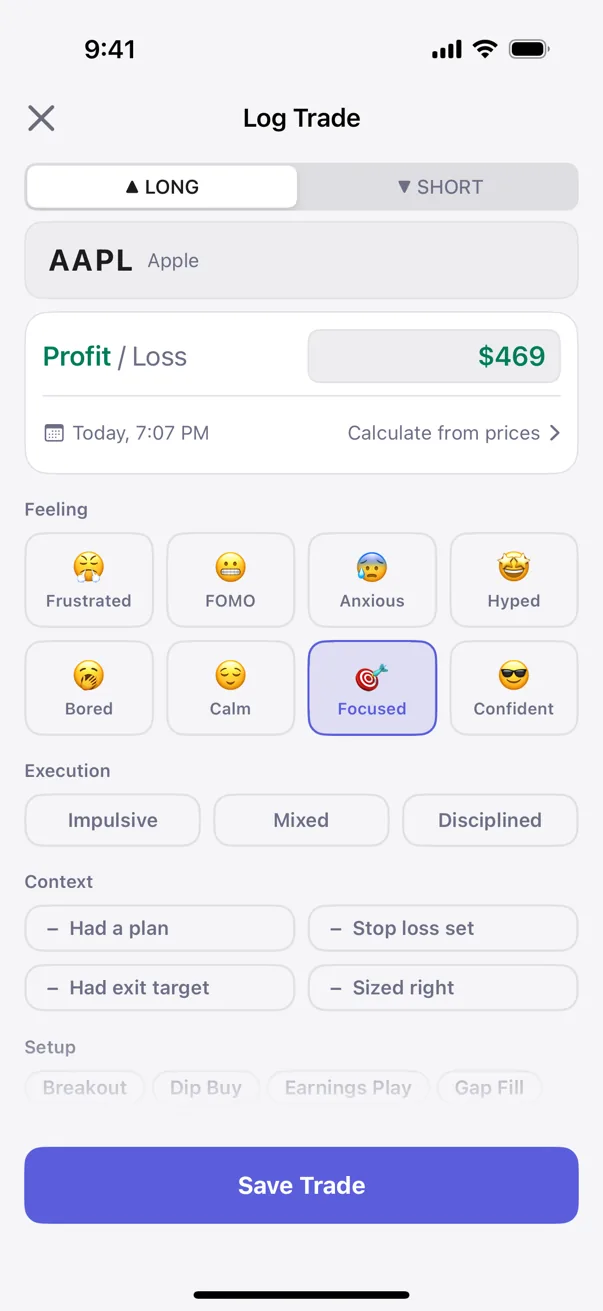
What is a trading emotion tracker? It is a journal that connects the emotional state recorded on a trade with the trade's context and outcome, so you can review whether states such as frustration, FOMO, anxiety, or focus repeatedly coincide with different results. Kyra does this inside the trade log instead of keeping a separate mood diary.
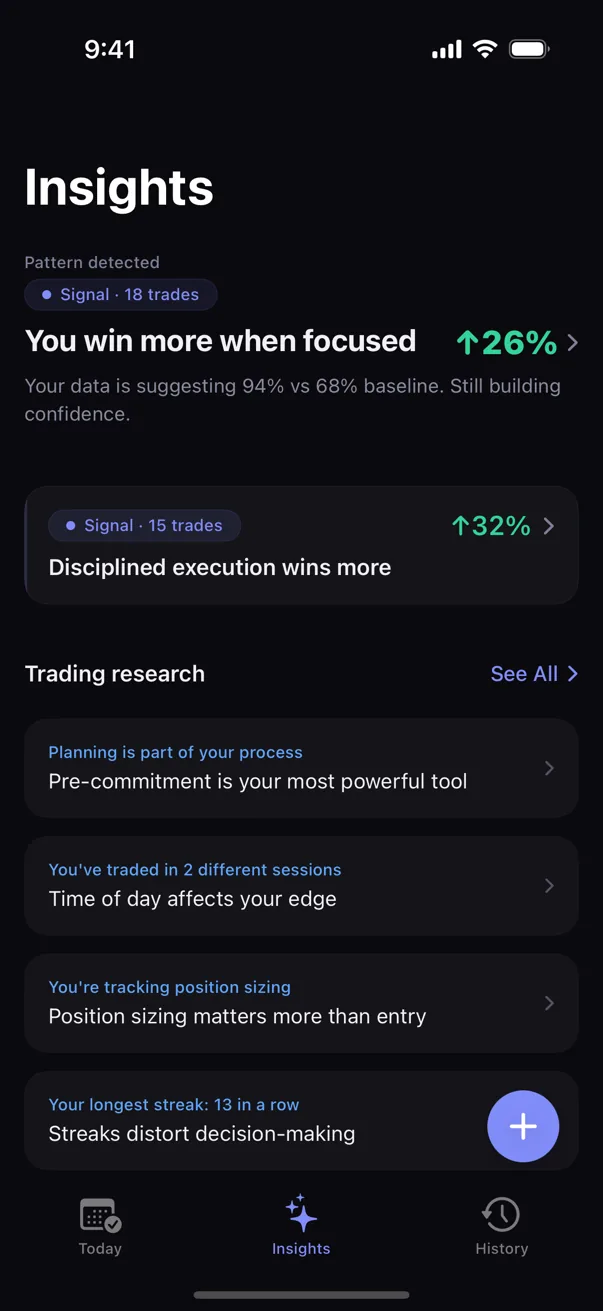
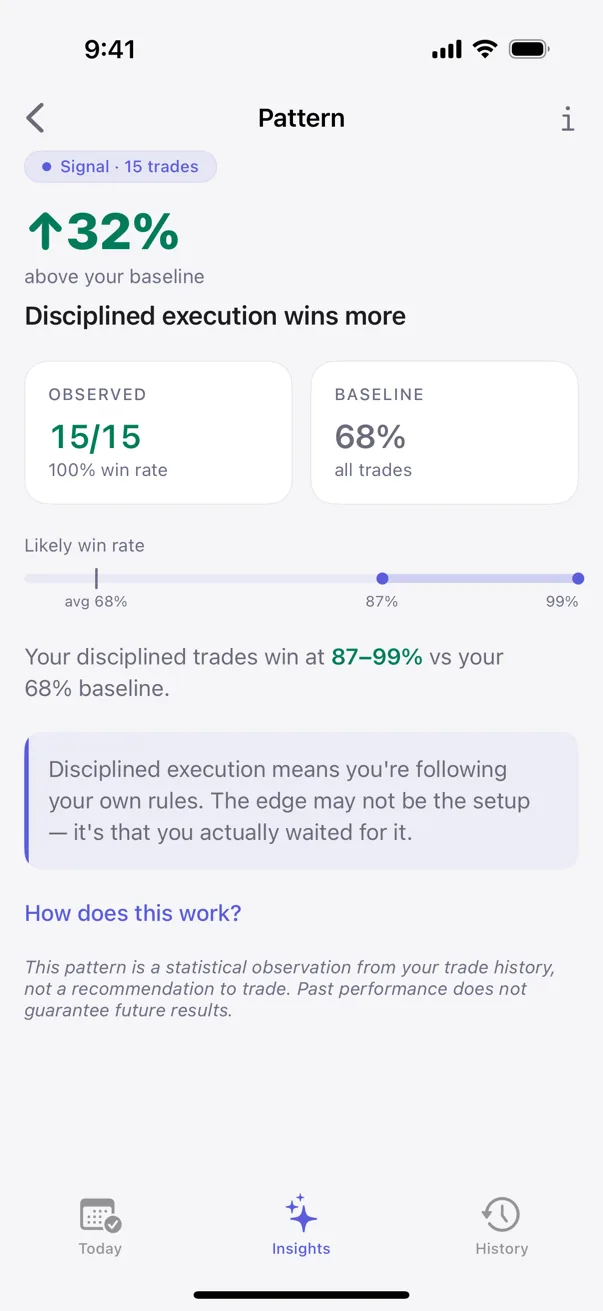
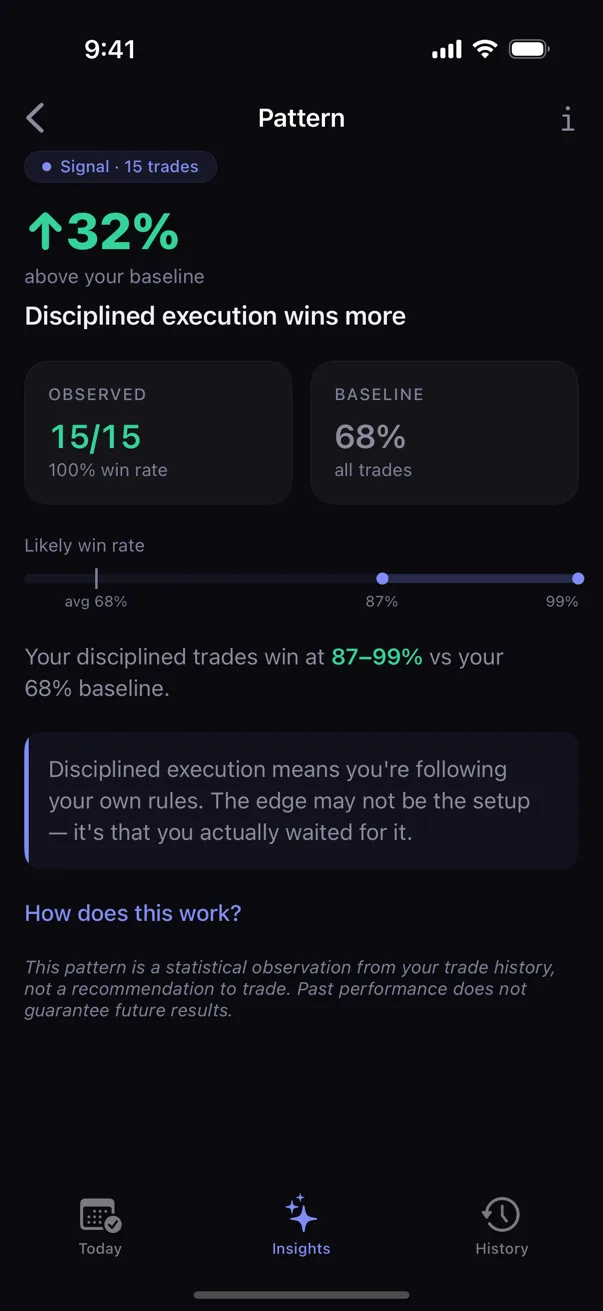
Track the state, not a story
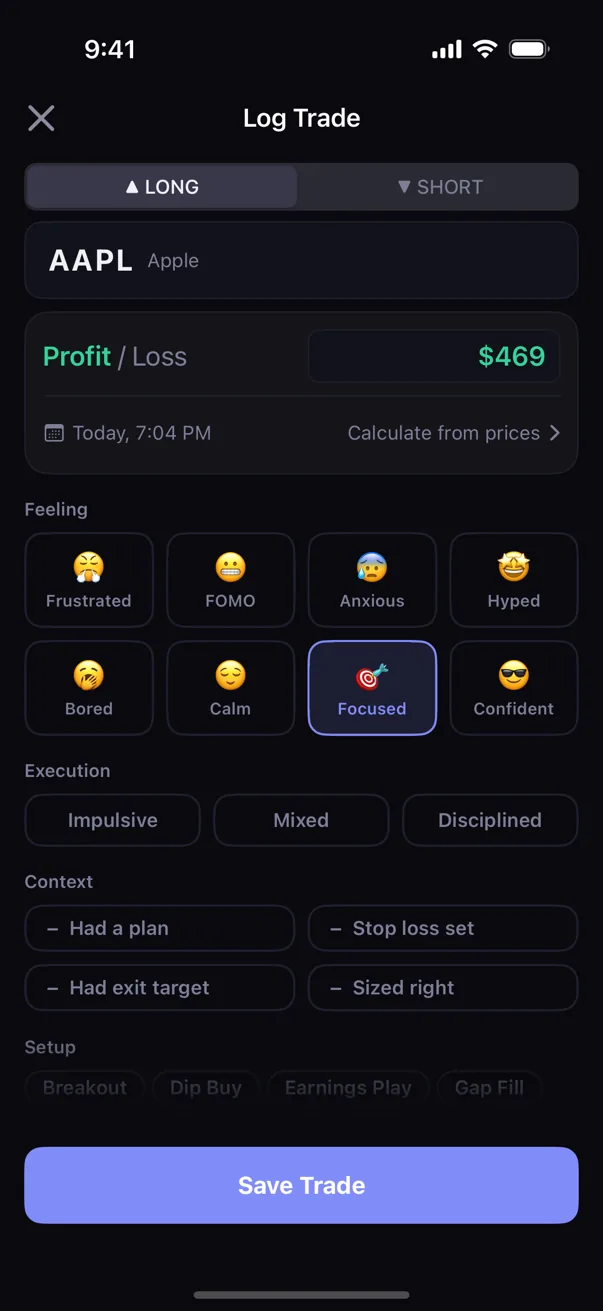
Kyra uses one fixed state per trade. That gives the journal a repeatable field it can compare across the rest of your trade history instead of a pile of free-form reflections that mean something different every week.
The vocabulary is deliberately fixed. The useful question is not whether today's note sounds insightful. It is whether the same state, attached consistently to many trades, shows a repeatable difference from your baseline.
How Kyra turns emotion into evidence
- Log the trade and the stateThe emotion lives on the trade itself, next to the context Kyra can analyze later.
- Let history accumulateKyra compares outcomes across your own logged history rather than drawing a conclusion from one memorable win or loss.
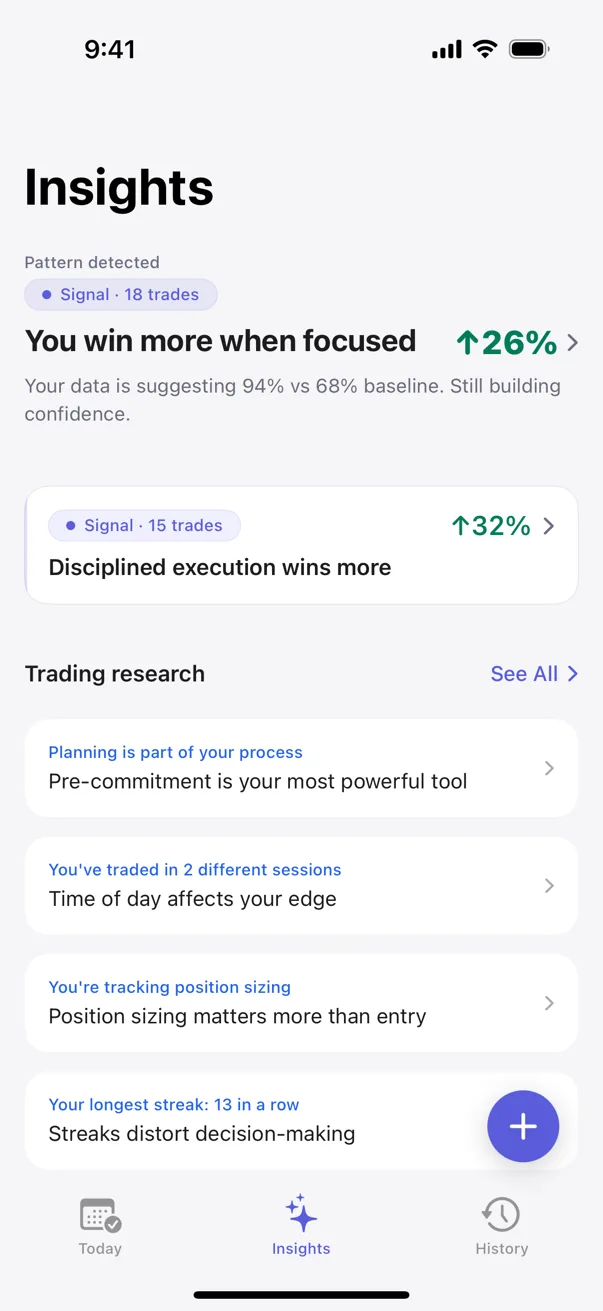
- Read the observation with its evidenceDetected patterns expose the sample behind them and an uncertainty range, so you can distinguish an early hint from a pattern backed by more relevant trades.
That is also why Kyra does not need you to diagnose every mistake while you are making it. Record what was observable, then let the pattern engine test whether it mattered. See pattern detection and the methodology for the statistical side of that workflow.
Mood tracking for traders vs. trade-linked emotion tracking
| Question | General mood tracker | Kyra |
|---|---|---|
| What gets recorded? | How the day or moment felt | One state attached to a specific trade |
| What is it compared with? | Usually time, habits, or notes | The trade and the rest of your logged trading history |
| What is the output? | Mood history or reflection | Detected trading observations with supporting sample information |
| Where is analysis performed? | Depends on the app | On your iPhone |
A general mood app can be useful for understanding your day. Kyra is narrower: the state is useful because it is attached to a trading decision and can be examined alongside the result. If you want the logging method itself, read how to track trading emotions.
Evidence, not an AI coach's interpretation
Many trading-psychology products are built around generated coaching or narrative summaries. Kyra's core mechanism is different: it runs statistical pattern detection on the trades you logged and shows the sample behind an observation. A handful of anxious trades should look like a small sample, not a grand diagnosis.
The same principle applies beyond emotion. Kyra can analyze dimensions such as setup, timing, execution, and other logged context, then use detected patterns to make the premium pre-trade checklist adaptive. The journal remains a record first; the analysis has to earn its conclusion from that record.
Your trading psychology data stays on your device
Kyra's analysis runs on-device and there is no Kyra account. That matters for emotion tracking because the journal can contain more than P&L: it can contain how you were feeling, what you planned, and how you executed. Read why Kyra runs on-device and the security overview for the storage and sync boundaries.
Free vs. Premium
| Free | Premium |
|---|---|
| Unlimited logging with the emotion field, full history, and the first detected patterns. | All detected patterns, detailed breakdowns, and the adaptive pre-trade checklist. |
See pricing or view Kyra on the App Store.
Questions traders ask about emotion tracking
Can Kyra track FOMO or revenge trading?
FOMO is one of Kyra's eight available states. Revenge trading is different: Kyra does not ask you to declare a trade a "revenge trade" at entry and it does not block you from placing trades. The journal records your state and trade context so repeated behavioral patterns can be measured later. See how to stop revenge trading for the behavioral workflow.
Is Kyra a mood tracker?
Not in the general wellness sense. Kyra records a state on a trade so that state can be compared with trading outcomes and context. It is better described as a trading journal with emotion tracking.
Does Kyra send my journal to an AI service?
Kyra's pattern analysis runs on-device and the app does not require a Kyra account. The public security and privacy pages document the current data boundaries.
Kyra analyzes the history you record. A detected pattern is an observation about that personal dataset, not a prediction, trading signal, or financial recommendation.