A journal has exactly one job
A trading journal exists to be an honest record you can mine for patterns. That's the whole asset. Its value is its accuracy — the degree to which what's logged matches what actually happened, in your trades and in your head at the time. Everything useful a journal can do later, from spotting your most expensive emotion to ranking your setups, depends on the record being true first. What you choose to log is the decision that determines whether patterns can ever surface.
So the test for any journal feature is simple: does it make the record more honest, or less? A streak fails that test. It's a brilliant feature for an app that wants you to open it daily, and a corrosive one for a tool whose only purpose is accuracy — because the two goals pull in opposite directions.
What a streak actually rewards
A streak doesn't reward honest logging. It rewards the act of logging, or the appearance of a good day. Those are different things, and the gap between them is where the damage lives. It shows up two ways.
First, it changes whether and when you log. You start logging to protect the number, not to reflect — a rushed entry at 11:58 p.m. to keep the chain alive is logging-shaped, but it isn't reflection. Worse, on the days that most need an honest entry — the blow-up, the rule you broke — the streak gives you a reason to look away, because a green chain feels better than a true one.
Second, and more corrosive, it changes what you log. Once there's a score attached to good days, every ambiguous call tilts toward the flattering version. The exit gets rounded up. The emotion gets recorded as "focused" instead of "hyped." The impulsive trade gets a generous setup tag. None of it feels like lying. It feels like giving yourself the benefit of the doubt — which is exactly how a dataset rots.
Goodhart's law comes for your journal
There's a name for this failure. When a measure becomes a target, it stops being a good measure — Goodhart's law, in the form the anthropologist Marilyn Strathern made famous [1]. The moment you put a score on something, people optimize the score, and the score detaches from the thing it was supposed to track.
A streak is a measure of consistency. Make it a target — give it a number, a flame icon, a "personal best" — and people optimize the streak. They protect the chain, game the green day, log to keep the count. The number stays high and impressive while the thing it claimed to measure, honest consistent review, quietly stops happening. You've built a metric that lies most precisely when it looks best.
Rewards crowd out the reason you started
It gets worse, because the damage isn't only to the data — it's to your motivation. The research here is old and robust: external rewards can undermine the intrinsic motivation to do the underlying activity. In the foundational study, people paid to do a task they'd previously enjoyed became less inclined to do it once the pay stopped [2]. The reward doesn't just sit alongside the real reason — it can replace it, and when the reward fades, so does the behavior.
Gamify reflection and you risk swapping "I review because it makes me a better trader" for "I review for the badge." That trade feels fine right up until the badge gets boring — and then the habit you were trying to build collapses, because its real foundation was quietly dissolved. Adding an incentive isn't neutral; it reframes the activity. The classic demonstration is a daycare that started fining parents for late pickups and saw lateness increase — the fine reframed a moral obligation as a purchasable service [3]. A streak can do the same to your journal, turning a practice into a points game.
Why this is worse for a trading journal than a habit app
A streak on a meditation app is mostly harmless — the worst case is you meditate to keep a number, which is still meditating. A streak on a trading journal is different, because the data isn't the end product. It's the input to decisions: which patterns you trust, which setups you keep, how you size, what you fix. Corrupt the record and you don't just feel good about nothing — you feed a flattered dataset into the exact process meant to find your leaks.
A journal that nudges you to over-record wins and soften losses will hide the behavioral leak you most need to see. The leak that's costing you is, by definition, the one you don't want to look at — and a streak is a machine for not looking at it. The cruelest version: the better the app makes you feel, the less it can help you.
What honest feedback looks like instead
The alternative to gamification isn't a feature-less void. It's feedback aimed at the trading, not the logging. A journal can be motivating by being useful — by surfacing a real pattern with the sample size behind it, by showing your P&L plainly, by letting a quiet stretch be quiet. There's nothing wrong with recording an exit precisely; the P&L calculator gives you the real number with no confetti attached, and a plain journal template logs outcomes instead of points. The pull to improve comes from seeing something true about yourself, which is a deeper and more durable motivation than a flame icon.
Crucially, that means a day with no trades is just a day with no trades. Not trading is frequently the correct decision, and any system that penalizes a flat, disciplined day — that dims the calendar cell, breaks the chain, costs you points — is training the wrong behavior. It's quietly rewarding activity over judgment, which is the opposite of what a trader needs.
The standard Kyra holds
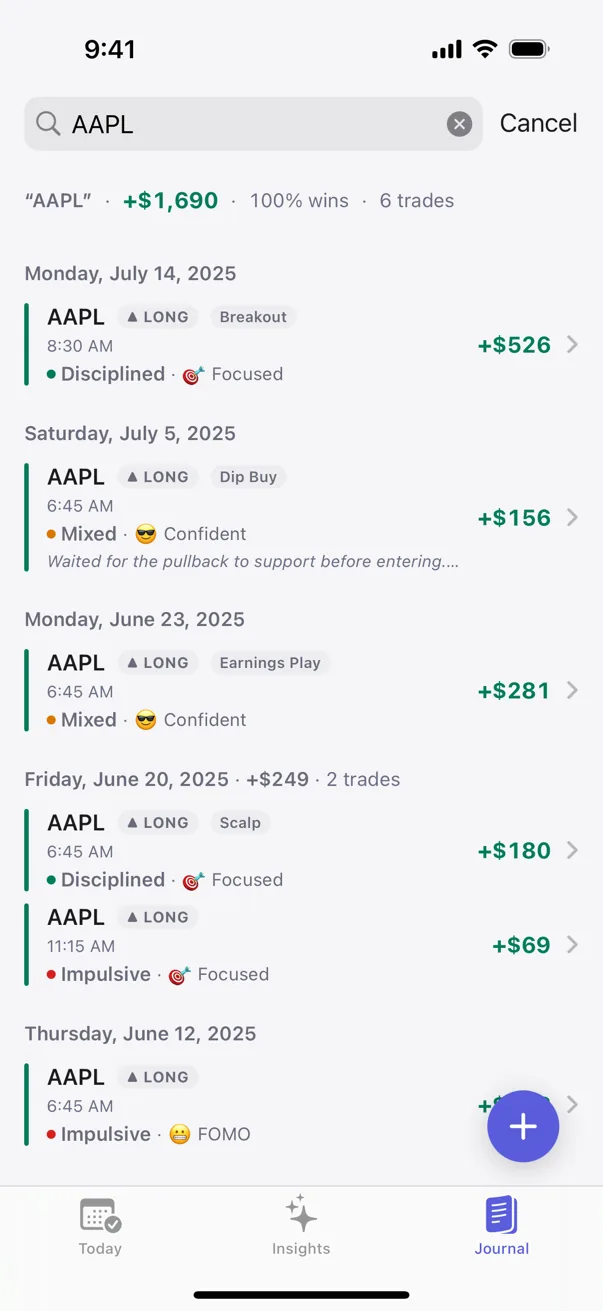
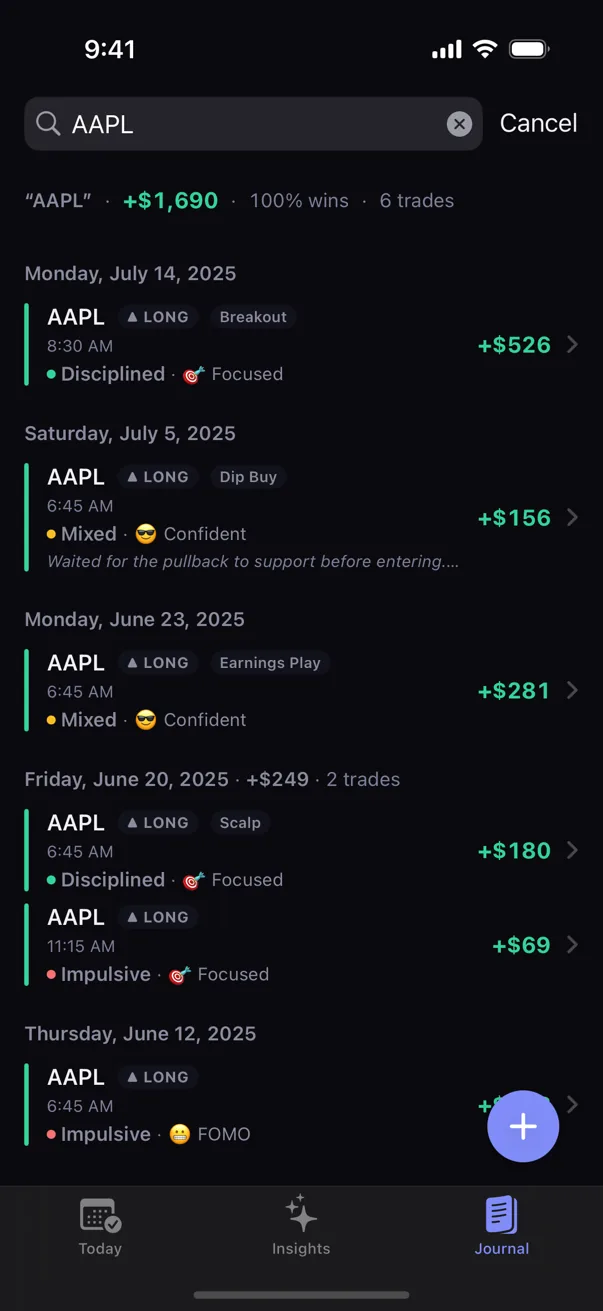
This is a deliberate line, not an oversight. Kyra has no streaks, no XP, no badges, no leaderboards — by design and on principle. Its surfaces show your patterns and your numbers, each tagged with how much data stands behind it, and a day you didn't trade is simply absent, never penalized. The point is to be a tool you can trust precisely because it never tries to flatter you or hook you.
Pattern detection runs on-device — no accounts, no servers — and it reads whatever you actually logged. Which is the whole argument for keeping the log honest: the engine can only be as truthful as the record you give it, so the record is built to have no reason to lie. A journal's only job is to be right.
Sources
- Strathern, M. (1997). 'Improving ratings': audit in the British University system. European Review, 5(3), 305–321. (The widely cited formulation of Goodhart's law: "When a measure becomes a target, it ceases to be a good measure.")
- Deci, E. L. (1971). Effects of externally mediated rewards on intrinsic motivation. Journal of Personality and Social Psychology, 18(1), 105–115.
- Gneezy, U., & Rustichini, A. (2000). A fine is a price. The Journal of Legal Studies, 29(1), 1–17.
Educational only. Not financial or trading advice. Behavioral mechanisms described above are observations from the published literature; specific outcomes vary with individual circumstances.