Consistency matters because missing trades are not random
The trade you are most likely to skip is rarely a representative one. Clean winners are easy to record. The awkward loss, the impulsive entry, the late chase, and the day that got away from you are exactly the records that create friction. If those trades disappear from the journal, the dataset gets cleaner than the trading actually was.
That is why the first goal of a trading journal is not detail. It is coverage. A modest record that includes the uncomfortable trades is more useful than a beautiful record that quietly excludes them.
Make the minimum useful record genuinely small
Start with what you need to identify the trade and compare it later: symbol, direction, result, and the few decision fields you intend to use consistently. If emotion, setup, or execution matters to your review, use a fixed vocabulary rather than inventing a new phrase every time.
The companion question, what to include in a trading journal, goes deeper on which fields earn their place. For consistency, the rule is simpler: every required field increases the cost of capture. If a field is not going to change a later review, it should not stand between you and saving the trade.
Capture facts close to the trade, interpretation later
Memory edits. After the result is known, the entry feels more obvious, the plan feels clearer, and the emotion is easier to rationalize. A classic diary-compliance study in another domain showed why timing matters: records that look complete on paper can still be reconstructed later rather than captured when they were supposed to be [1]. A trading journal has the same practical vulnerability even if the subject is different.
So separate the jobs. During the session, record facts: what you traded, what happened, the state you were in, and the context you know now. During review, ask what it means. Trying to perform both jobs at once turns a ten-second capture into a mini essay, which is how the habit disappears.
Use a cue instead of waiting to remember
A habit becomes more reliable when it is attached to a specific event. Implementation-intention research describes this as linking a situation to a pre-decided response: when X happens, I do Y [2].
For a journal, the cue can be almost mechanical:
- Trade closesLog the result and the context while the trade is still fresh.
- Session endsCheck that the day's trades are present. Do not start a deep analysis yet.
- Week endsReview process and repeated behavior across the sample, not one memorable trade.
The useful part is the separation. Logging has a cue. Review has a cue. Neither depends on being in the mood to journal.
Do not punish a missed day with a giant catch-up session
Missing a day is not the point where a journal breaks. The break happens when the missed day creates a backlog so large that reopening the journal feels like a project.
If you miss trades, reconstruct only what you can verify, label uncertainty honestly in your own notes, and restart the normal capture routine with the next trade. Do not turn an incomplete record into a fictional complete one just to make the calendar look tidy.
Review on a different cadence from logging
Daily P&L is emotionally loud and statistically small. It is useful for recall, not for declaring that a setup works or that a behavior is fixed. The deeper job belongs to a weekly trade review, where enough observations can sit next to one another to expose repeated process.
A simple rhythm is enough:
- After each trade: capture the record.
- After the session: check completeness and add a short day reflection if useful.
- Once a week: inspect setup, state, execution, timing, and rule adherence across the sample.
- After enough trades: treat patterns as evidence with sample size, not as a verdict from one week.
What consistency looks like in Kyra
Kyra keeps the capture path intentionally short. You can record a completed trade with Quick P/L or add exact price detail, then attach context such as emotion and setup. The Log Trade action can open the entry form from Spotlight, the Shortcuts app, or an Action Button, and Kyra 1.6 also includes Home Screen Quick Actions for faster entry. None of those routes logs a trade automatically; they reduce the distance between remembering and opening the form.
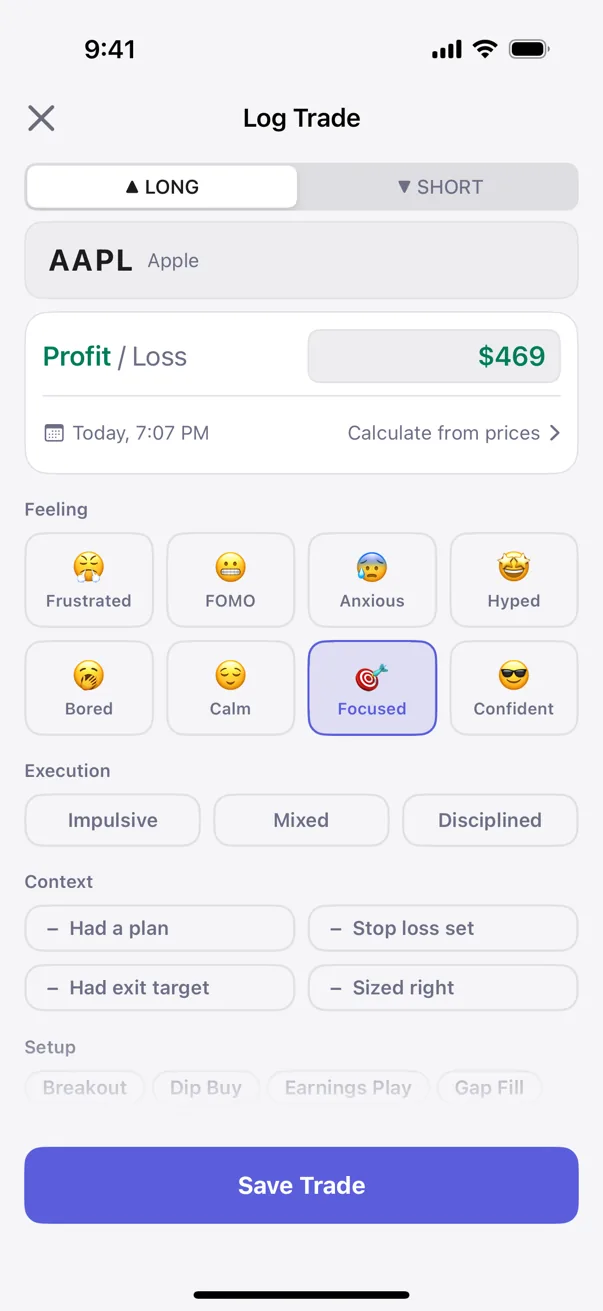
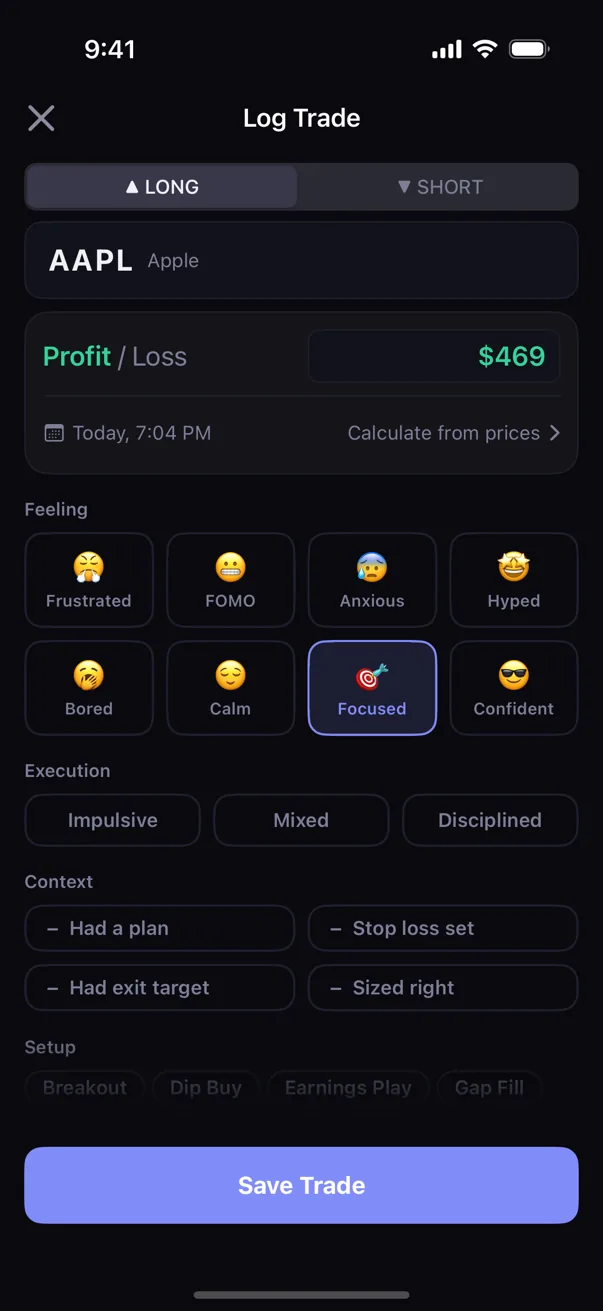
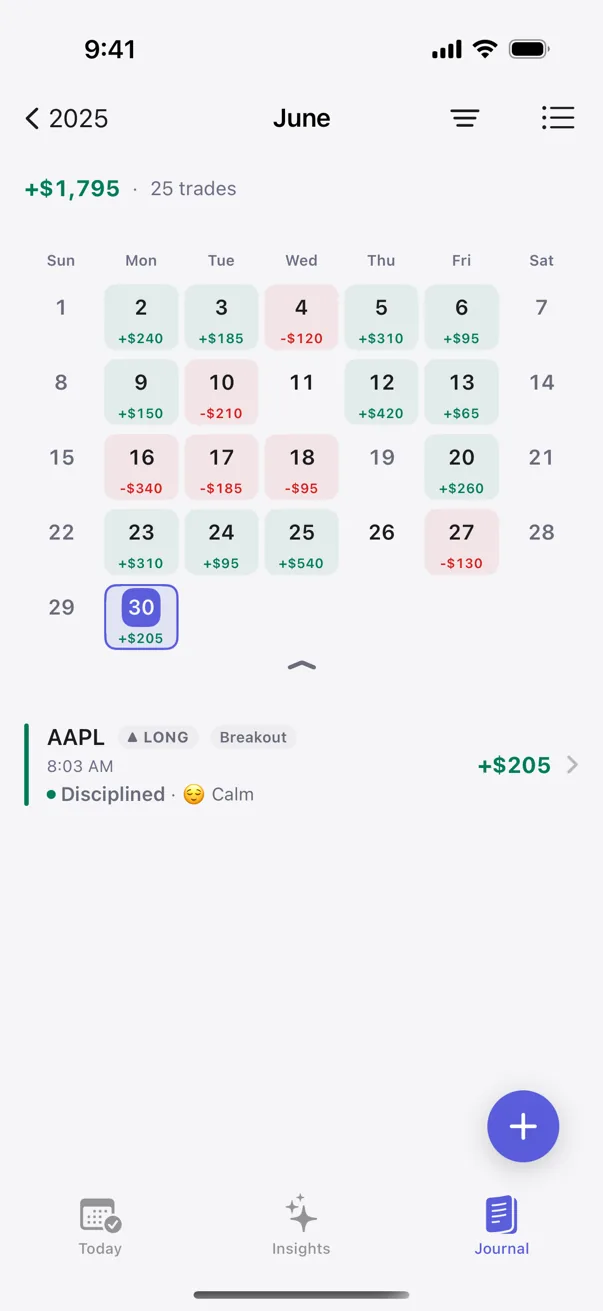
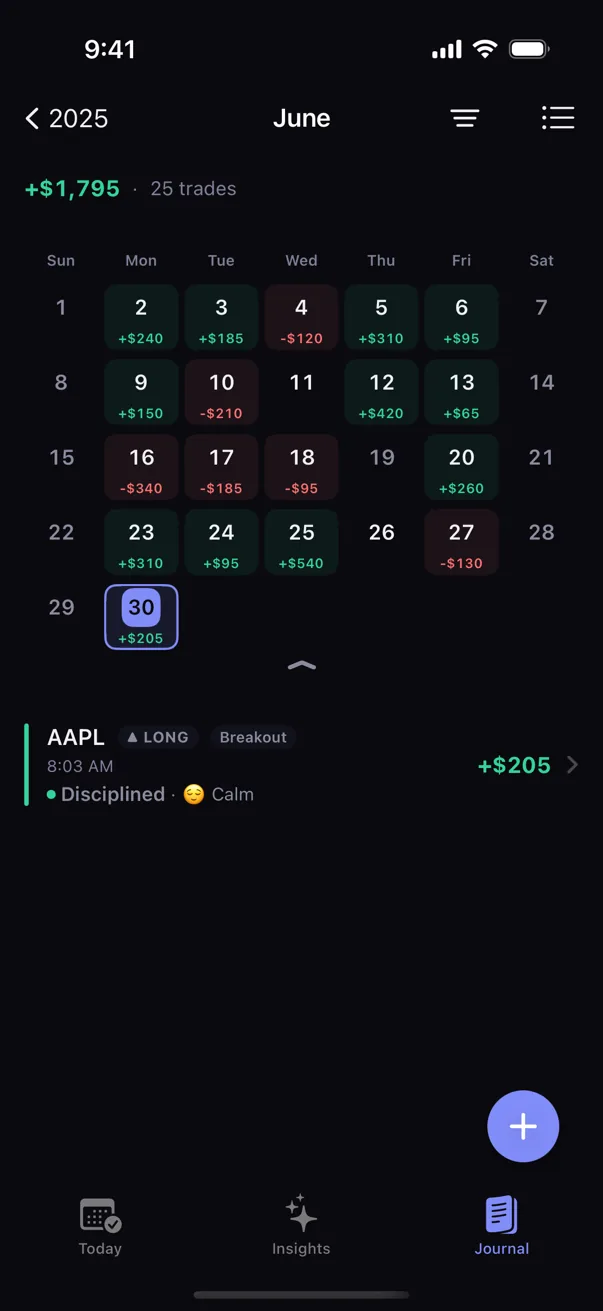
The other half is retrieval. Journal lets you search and filter the history, while the P/L calendar lays results out by day so a missing session or clustered stretch is visible without rebuilding the week from memory. That makes the habit a loop: capture quickly, then review the same record later.
A seven-day reset for a journal you stopped using
If your journal has been abandoned, do not redesign it first. Run the smallest version for one week:
- Choose the minimum fieldsOnly the facts you will actually use in review.
- Attach logging to the closeThe closed trade is the cue. Capture before moving on.
- No essays during the sessionRecord the state and facts. Interpretation waits.
- Check completeness at day's endFix obvious omissions while the session is still recent.
- Review once at the end of the weekAsk what repeated, not which single trade was most dramatic.
If that version survives seven ordinary trading days, then add detail. A journal earns complexity only after the basic record is reliably there.
Sources
- Stone, A. A., Shiffman, S., Schwartz, J. E., Broderick, J. E., & Hufford, M. R. (2002). Patient non-compliance with paper diaries. BMJ, 324(7347), 1193–1194.
- Gollwitzer, P. M. (1999). Implementation intentions: Strong effects of simple plans. American Psychologist, 54(7), 493–503.
Educational only. Not financial or trading advice. A complete journal can improve the quality of your review, but it does not make trading profitable or remove market risk.