What moving the stop really is
A stop loss is a decision made in advance: this is the price at which the trade is wrong, and at that price I am out. The number encodes a plan — how much this position is allowed to lose before the thesis is declared dead. Setting it is the act of bounding the loss.
Moving that stop further away, as price runs toward it, undoes the bound. The loss the trade can now produce is no longer the one you sized for; it is whatever the next leg down delivers before you flinch again. A planned, capped loss becomes an open-ended one — and it does so at the exact moment the plan was supposed to fire.
The timing is the whole problem. The stop was set when nothing was at stake and the analysis was cold. It is moved when the position is red and against you — when the decision-maker is no longer the one who set the rule. You are not refining the plan. You are deleting it, and you are deleting it at the worst possible moment to be making decisions.
The bounded loss
Price hits the level set at entry and the trade is closed. The loss is exactly the one you sized for — known in advance, paid, and done. The plan did its job.
The open-ended loss
The level is dragged lower to give the trade "room." The loss is now whatever the next leg delivers. The cap is gone, and the trade you sized small can lose large.
Why you do it
Moving the stop is not carelessness. It is loss aversion doing exactly what loss aversion does. Prospect theory established that a loss of a given size hurts more than a gain of the same size pleases [1] — the value function is steeper on the loss side. Letting the stop fire means realizing the loss: converting a paper drawdown into a booked one and admitting, on the record, that the trade was wrong. That admission is the painful act, so the brain reaches for the move that postpones it.
And there is always a story to justify the move. "The stop was too tight." "This is just a wick — give it room." "It will come back; I just need to survive this candle." Each rationalization feels locally reasonable, which is what makes it dangerous. The trader is not deciding to abandon risk management. Each individual nudge feels like patience, like conviction, like not getting shaken out. It is only across many trades that the nudges add up to a pattern.
This is the exit cousin of the disposition effect — the documented reluctance to realize losses, the tendency to ride losers too long, first formalized by Shefrin and Statman [3] and measured directly in Odean's study of brokerage records, where individual investors realized their gains at a far higher rate than their losses [2]. The disposition effect, covered in detail in the disposition effect, is about holding a losing position open all the way to the exit. Moving the stop is the specific mechanical act that lets that holding happen: the protective order was the one thing standing between the trader and an unbounded loss, and dragging it out of the way is how the loser gets the room to keep running. Same loss aversion underneath; this article is about the moment your hand goes to the stop.
The asymmetry
Ask any trader who moves stops and they will have a memory of the time it saved them — the level they widened, the reversal that followed, the trade that came back green. Those memories are real, and they are why the habit persists. What the memory leaves out is the other tail: the times the move turned a small, planned loss into a large, unplanned one.
The reason the habit loses money is not that moving the stop never works. It is that the wins are small and bounded — the trade comes back, you make roughly what you would have made anyway — while the losses are large and unbounded. A move that "saves" the trade saves a normal-sized outcome. A move that fails removes the cap entirely, and the loss runs until you finally give up. The few large losses dominate the average, and no number of small saves offsets them. That is the shape loss aversion can't see from inside a single trade.
The figure is built from things a trade log already holds: the planned risk recorded at entry and the loss actually realized at exit. The gap between them is the cost of the move, and it is visible from the numbers alone — no memory of how any single decision felt is required.
The fingerprint in your log
Moving stops leaves a legible trace, because the planned risk and the realized loss are both recorded and they stop agreeing.
- Realized losses larger than the plan. The clearest tell. If a trade was sized to risk 1R and closed at −2.5R, the loss ran past where the stop was supposed to cut it. A scatter of losses well beyond −1R is the move showing up after the fact.
- Stops widened or removed mid-trade. The stop set at entry and the level the trade actually closed at no longer line up. The protective order was either dragged lower or pulled entirely while the position was open.
- Clustered on the "had to be right" trades. The moves are not random. They concentrate on the high-conviction positions — the ones with the thesis you were most attached to, the ones where being stopped out would have stung the most. That is exactly where loss aversion bites hardest.
The diagnostic is the divergence between intended risk and realized loss. A stop that was honored produces a loss at or near the planned level. A stop that was moved produces a loss past it, and the size of the overrun is the size of the problem — all of it readable from data already in the log.
The rule that works
The fix has the same shape as every fix for an exit bias: move the decision out of the moment, where loss aversion fires, and back to before the trade, where it doesn't. The principle is one line — the stop is set at entry and only ever moves toward you, never against you. Decide it when calm; honor it when not.
1. Set the stop at entry, and treat it as fixed
Before you enter, define the price at which the trade is wrong, and place the order there. Once it is set, the only acceptable change is the trade closing — at the stop or on your own decision to exit early. "The stop moves only when the trade is over" is binary: either price hit the level or it didn't, and there is no judgment call left for loss aversion to bend. The stop you set while calm is the one that runs.
2. Let it move toward you, never against you
There is a legitimate version of moving a stop: tightening it as the trade works. Once a position is in profit, the stop can ratchet up to breakeven, then trail behind price to lock in gains. That direction reduces risk — it can only ever cap the loss tighter or convert the trade to a free one. Moving the stop the other way, further from price to give a loser room, is the only direction that adds risk, and it is the one the rule forbids. Toward you, always; against you, never.
3. Size the trade so the stop is survivable
Stops get moved most often when they were too big to sit through in the first place — when the loss at the planned level feels like too much to accept, so the trader flinches and widens it. The fix is upstream: size the position so the loss at the stop is one you can take without blinking. A position size calculator turns that into a fixed number of shares or contracts for a given stop distance, and a risk/reward calculator checks that the target is worth the stop you set — so the loss you committed to is small enough that honoring it never feels like a crisis. A stop sized to survive is a stop you don't reach for.
Measuring it
Knowing you shouldn't move stops is not the same as knowing whether you do, or how much it costs you. Self-narrative is no help here — "I respect my stops" is exactly what the trader widening one believes, right until the realized losses say otherwise. The honest answer is in the gap between the risk you planned and the loss you took, across many trades.
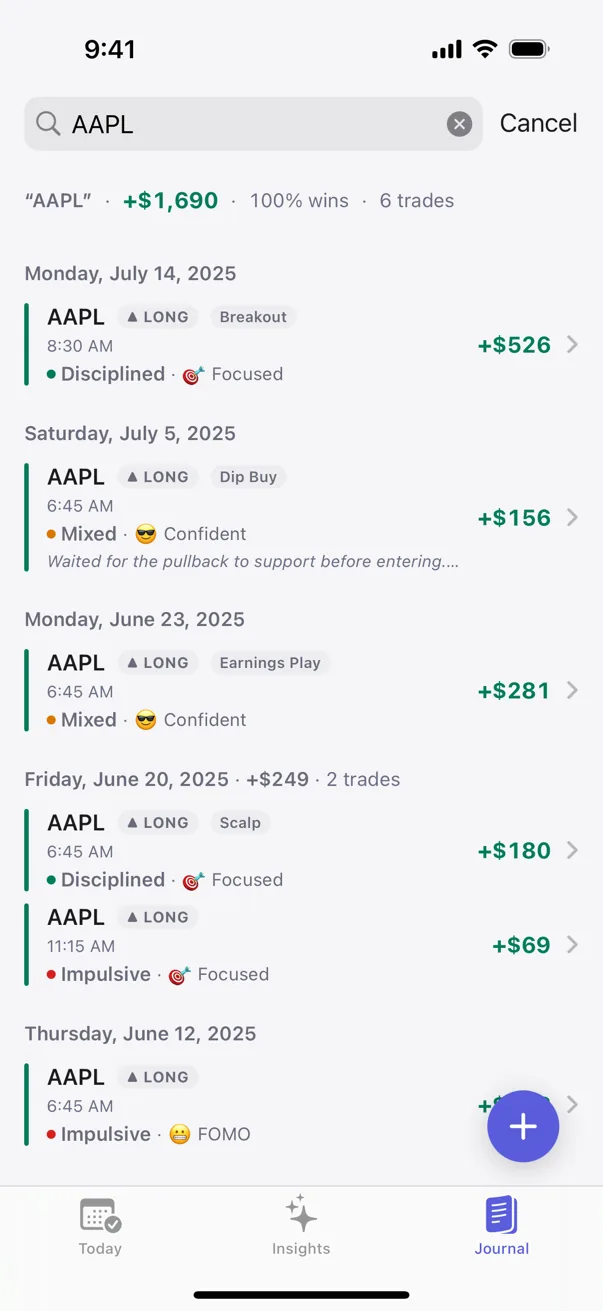
Behavioral pattern detection closes that gap. Kyra flags the trades where the realized loss ran past the planned risk — the stop-loss-intent signal — and surfaces that subset as a pattern with a sample size, so you can see how the trades where you moved the stop actually performed against the ones where you held it. The output is not a warning ("don't move your stops"). It is a measurement: the trades where your loss exceeded plan returned X across a sample of N. A number pulled from your own exits is harder to argue with than a generic caution.
Kyra Trading is a private trading journal that does this detection on-device. It uses on-device statistical testing to separate a repeated stop-discipline pattern from noise, and every pattern surface carries its sample size and a confidence range, so the trader can see how strong the signal is — patterns move through Tracking, Emerging, Developing, and Established tiers as the evidence accumulates. Nothing leaves the device. Pattern detection runs locally, no accounts, no servers. The trader's data stays the trader's data.
Sources
- Kahneman, D., & Tversky, A. (1979). Prospect Theory: An Analysis of Decision under Risk. Econometrica, 47(2), 263–291.
- Odean, T. (1998). Are Investors Reluctant to Realize Their Losses? The Journal of Finance, 53(5), 1775–1798.
- Shefrin, H., & Statman, M. (1985). The Disposition to Sell Winners Too Early and Ride Losers Too Long: Theory and Evidence. The Journal of Finance, 40(3), 777–790.
Educational only. Not financial or trading advice. Behavioral patterns described above are observations from the published literature; specific outcomes vary with strategy, market conditions, and individual circumstances.