The list is about everyone but you
There is no shortage of articles ranking the most profitable setups. The trouble isn't that they're wrong — it's that they describe a population. A "best setup" list is an average across thousands of traders with different instruments, different timeframes, different reflexes, and different temperaments. The average says nothing about whether you can execute it.
The same setup in two different hands is two different trades. A breakout traded by someone who waits for the retest and sizes calmly is not the breakout traded by someone who chases the first green candle and bails on the first wick. The chart pattern is identical; the edge is not. An edge is positive expectancy across a large enough sample, and expectancy lives in the execution, not the diagram. Which is why the only ranking that predicts your results is the one built from your own trades.
Best setups, in general
A population average — true across many traders, blind to your instrument, your timeframe, and how you actually execute. It ranks the pattern, not your edge in it.
Best setups, for you
The expectancy each of your setups has earned in your own log, over enough trades to trust. It ranks your execution — which is the thing that actually pays.
Why your gut is the wrong judge
Ask a trader which setup is their best and the answer comes fast and confident. It's also unreliable, for a reason that has been studied directly: people are bad at reading small samples and worse at telling a real streak from a lucky one.
The first problem is the law of small numbers [1]. People treat a small sample as if it were representative of the whole — six winning breakouts feel like proof that breakouts work, when six trades is far too few to separate skill from variance. The researchers showed that even professional scientists, trained in statistics, intuitively expected small samples to behave like large ones. A trader eyeballing their last handful of trades has no chance.
The second problem is the misperception of random sequences — the "hot hand" [2]. The original work showed that streaks people are certain are real (a basketball shooter who is "hot") are statistically indistinguishable from chance. We are built to see runs as meaningful. A setup that has paid three times in a row registers as working, even when the run is exactly what randomness produces. From inside the streak, a lucky setup and a genuine edge look the same.
Stack those two biases together and the "gut read" on your best setup is built from your most memorable trades, not your most representative ones — and memorable usually means dramatic, which usually means the outlier. That is precisely the trade you should weight least.
What "best" actually means
Even with a clean sample, "best" is easy to define wrong. The instinct is to rank setups by win rate, but win rate alone is misleading. A setup can win 70% of the time and still bleed you if the losers are large and the winners are small. Another can win 40% of the time and be your single most profitable play if the winners run.
The number that ranks setups honestly is expectancy — the average amount you can expect a setup to return per trade, win rate and average win/loss combined into one figure. A setup with a 45% win rate and winners twice the size of losers has a positive expectancy; one with a 65% win rate and losers twice the size of winners does not. The risk/reward calculator shows how the win rate and the average win-to-loss ratio trade off, and the glossary works the expectancy formula in full. Rank your setups by that, not by the feeling.
The fingerprint in your log
Tag every trade with the setup you took, and the question stops being a debate and becomes a sort. Group your trades by setup, look at the expectancy and win rate of each group, and attach the sample size so you know how much to trust each row. The shape that emerges is usually a surprise: the setup you're proudest of is middling, and a quiet one you barely think about is carrying the account.
Read that as a method, not a verdict. The labels are examples; your ranking is whatever your trades say. What matters is that the comparison is built from logged outcomes instead of remembered ones — which is the only way to get past the small-sample, hot-hand traps above.
How to use it
1. Tag the setup on every trade
You cannot rank what you didn't label. The discipline is to name the setup at entry, every time, including the ugly ones you'd rather not file. A few missing tags and the worst setup hides inside "untagged." If you're starting from a spreadsheet, the free trading journal template has a setup column built in.
2. Judge by expectancy, over a sample
Hold each setup to the same bar: positive expectancy across enough trades to mean something, not a good feeling from your last memorable win. A handful of trades is a guess; the read sharpens as the count grows. How many trades it takes before a pattern is trustworthy is its own question, and the honest answer is "more than you think."
3. Cut or shrink the bleeder before adding anything new
Most traders try to improve by adding setups. The faster gain is usually subtraction: find the setup with the worst expectancy in your log and either stop trading it or size it down hard. Removing a negative-expectancy play lifts the whole account without requiring you to get any better at anything. Use the P&L calculator to see what that one setup has actually cost you in dollars — the number is usually more motivating than the percentage.
Measuring it
The reason this is hard to do from memory is the reason it's easy to do from data. You don't recall your representative trades; you recall the dramatic ones, and the dramatic ones are the least representative. Your tags don't have that problem. Every trade already carries the setup you assigned it, and grouping outcomes by that tag turns "I think breakouts are my best" into a ranked list with sample sizes attached.
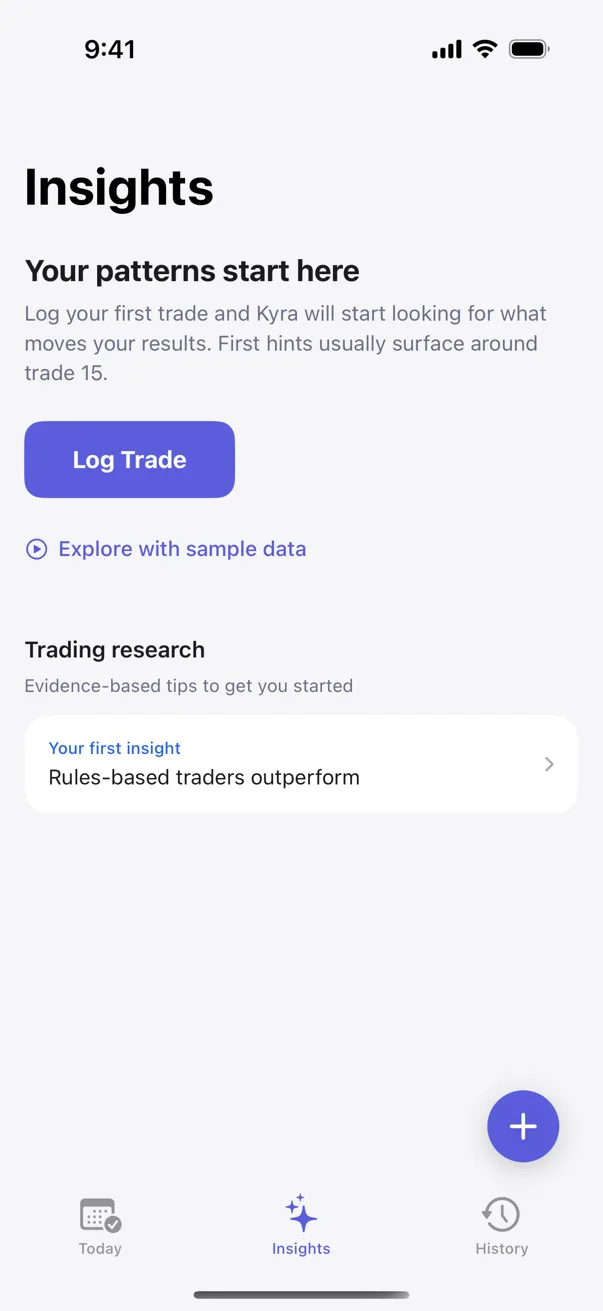
This is what behavioral pattern detection measures. Kyra groups your outcomes by setup and surfaces the ones where your win rate or expectancy runs above — or below — your baseline, with the sample size shown. The output isn't a generic "trade breakouts" tip. It's a measurement: the trades you tagged with this setup returned more, or less, than your baseline, with an uncertainty range that tightens as the sample grows.
Kyra Trading is a private trading journal that does this detection on-device. Its statistical engine tests each candidate pattern against chance and labels it by how much data stands behind it — Tracking, Emerging, Developing, or Established — so a setup signal earns trust only as the evidence accumulates. Every pattern surface includes the sample size and an uncertainty range. Nothing leaves the device. Pattern detection runs locally, no accounts, no servers. The trader's data stays the trader's data.
Sources
- Tversky, A., & Kahneman, D. (1971). Belief in the law of small numbers. Psychological Bulletin, 76(2), 105–110.
- Gilovich, T., Vallone, R., & Tversky, A. (1985). The hot hand in basketball: On the misperception of random sequences. Cognitive Psychology, 17(3), 295–314.
Educational only. Not financial or trading advice. Behavioral patterns described above are observations from the published literature; specific outcomes vary with strategy, market conditions, and individual circumstances.