Three fields. Logged.
Under 10 seconds per entry. No ticker or price math required.

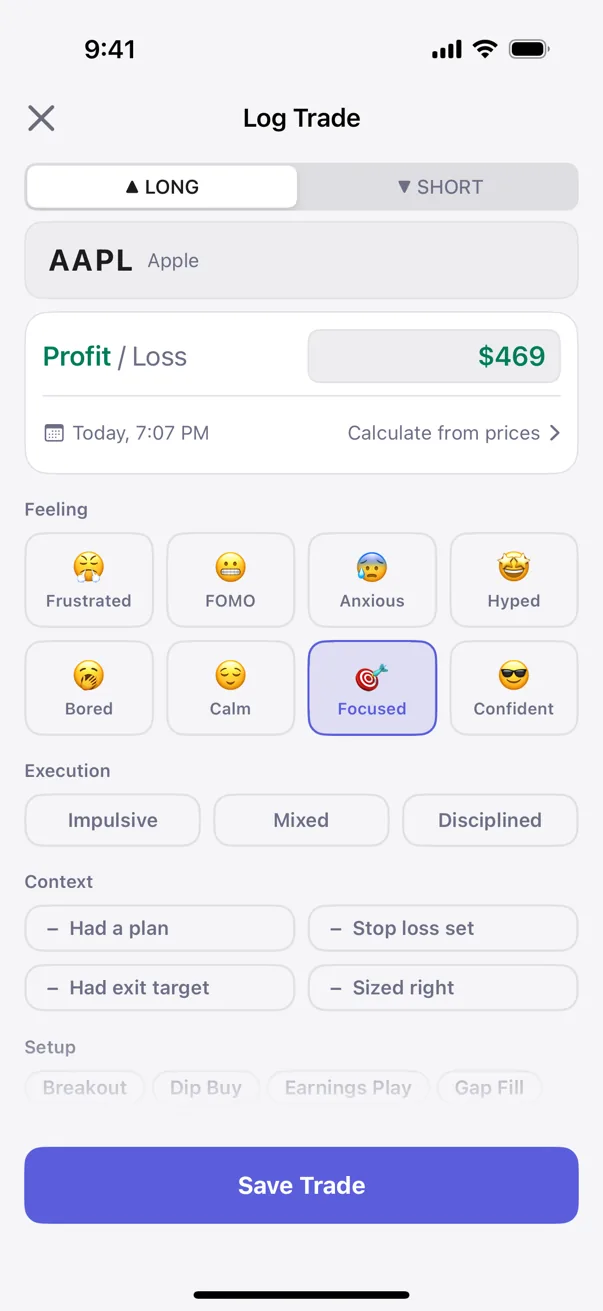
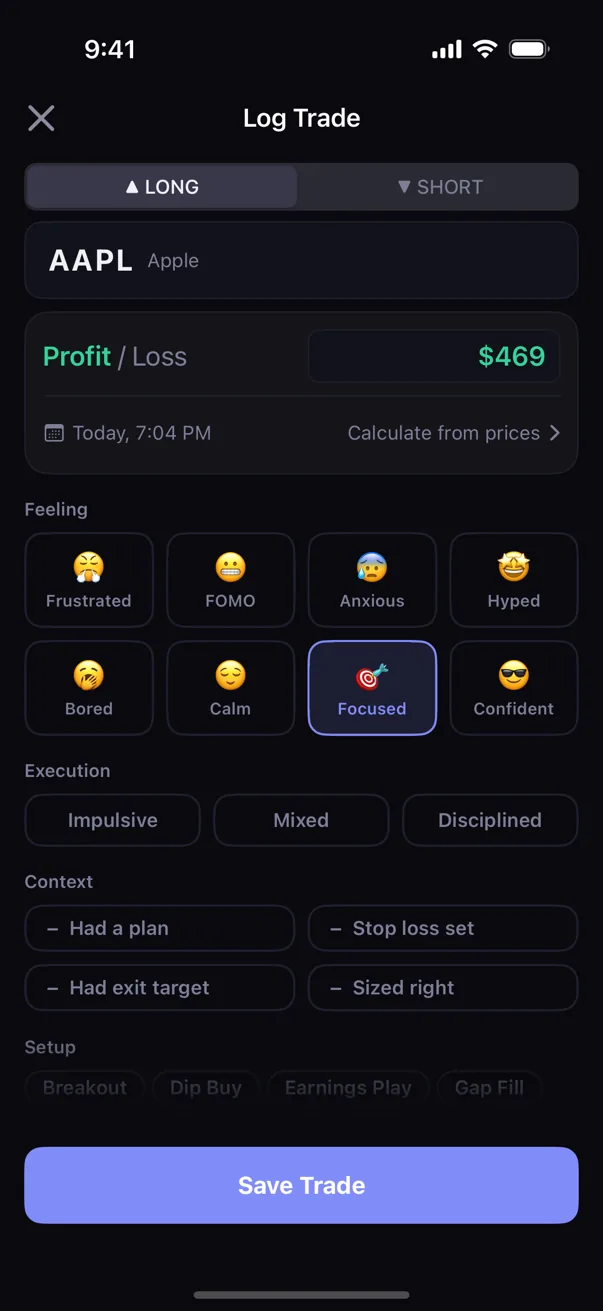
Choose the entry path the trade earns
Use Quick P&L
During an active session, for routine trades, or whenever capturing outcome and emotion now is more useful than reconstructing detail later.
Use full entry
When prices, sizing, setup tags, context flags, or a written reflection will matter in later review.
The mode is chosen per trade. Both routes land in the same history, and both support emotion and outcome analysis.
The 8-emotion picker
The emotion field uses the same fixed vocabulary as full entry:
- Calm
- Focused
- FOMO
- Hyped
- Anxious
- Frustrated
- Confident
- Bored
A fixed emotion field lets the engine compare like with like. Without it, a fast entry is only a P&L row; with it, the trade contributes to behavioral patterns.
Logging friction, honestly framed
- Full entry: ~30 seconds × 6 trades/day = 3 minutes/day
- Quick P&L: under 10 seconds × 6 trades/day = under 1 minute/day
Lower friction makes consistent per-trade journaling more realistic. A complete history is a stronger input for pattern detection than a detailed history with gaps.
What Quick P&L does not capture
Quick P&L omits ticker, prices, position size, setup, execution rating, context flags, and reflection. Use full entry when those dimensions matter to your later review.
Emotion and outcome patterns can use Quick P&L entries. Setup- or context-specific patterns can use only entries where those fields were recorded.
From entry to insight
Once a trade is logged, it is part of the local history the pattern engine examines. There is no separate upload step and no Kyra-operated server in the path.